This section of our website (which is updated daily) contains some less formal – and short – e-mail exchanges that we’ve had which we feel may be of value to our readers. We will include those portions of the exchanges we deem relevant and valuable. We often add bolding and underlining which are not necessarily that of the other party. This section also frequently includes, not only e-exchanges we have, but also our notes, updates and comments. Section containing some important recent posts. E-Exchange Archives.
These poignant photographs show jubilant fans at the Eagles Of Death Metal gig moments before they were massacred by... gunmen in Paris.
The pictures are clear enough to pick out individual faces in the crowd, some of whom were among the 89 victims slaughtered at the Bataclan Concert Hall on Friday night.
Some fans can been seen making the horn hand gesture that is popular within the heavy metal culture. Others are smiling for camera, raising their glasses or simply enjoying the music...
----
Dear Brothers,
The location with the highest numbers of casualties was the Bataclan Concert Hall where 89 people were killed. The people assembled at the concert were there to see a band called the Eagles of Death Metal. The song that the band was playing when the attack started is called "Kiss The Devil"... the lyrics are...:
Who'll love the Devil?
Who'll song his song?
Who will love the Devil and his song?
I'll love the Devil
I'll sing his song
I will love the Devil and his song
Who'll love the Devil?
Who'll kiss his tongue?
Who will kiss the Devil on his tongue?
I'll love the Devil
I'll kiss his tongue
I will kiss the Devil on his tongue
Who'll love the Devil?
Who'll sing his song?
I will love the Devil and his song
Who'll love the Devil?
Who'll kiss his tongue?
I will kiss the Devil on his tongue
Who'll love the Devil?
Who'll sing his song?
I will live the Devil and sing his song
The following are a few quotes which I wished to share... They are taken from a book by Saint Alphonsus de Liguori by the name of Verità della Fede, Truths of Faith. I found them interesting because of their contemporary relevance.
Saint Alphonsus condemned invincible ignorance as well as false religions and preached EENS
1. Introduzione: "... questi increduli moderni: e se mai taluno fosse rimasto abbagliato da' loro sofismi, apra gli occhi a riconoscere le verità della nostra Santa Fede, senza la quale non vi è speranza di salute."
1. Introduction: "... these modern incredulous: and if ever someone had remained blinded by their sophisms, that he open his eyes to recognise the truth of our Holy Faith, absent which there isn't hope of salvation."
2. Parte 2, Capitolo 1: "Ma perché, ... Iddio condannerà un infedele che ha ignorato invincibilmente il Vangelo? Si risponde che l'infedele si dannerà, non perché ha ignorato il Vangelo, ma per causa delle altre sue colpe. ... Il Cristiano fa bene, perché siegue una religione conforme a' dettami della natura e a' dogmi rivelati da Gesù Cristo; il Turco fa male, perché siegue una religione contraria alle leggi naturali ed alle verità rivelate, le quali perciò appunto sono dal Turco ignorate, perché non è vivuto secondo i lumi della natura. E quindi concludiamo che giustamente la religion Cristiana condanna la tolleranza delle altre religioni, ... "
2. Part 2, Chapter 1: "Yet why ... will God condemn an infidel who has invincibly ignored the Gospel? One responds that the infidel will himself, not because he ignored the Gospel, but due to his other faults. ... The Christian does well, because he follows a religion conformable with the dictates of nature and with the dogmas revealed by Jesus Christ; the Turk does bad, because he follows a religion contrary to the natural laws and the revealed truths, which are therefore indeed by the Turk ignored, because he has not lived according to the lights of nature. And thus we conclude that rightly the Christian religion condemns the tolerance of other religions, ... "
Saint Alphonsus confirmed sedevacantism
Parte 3, Capitolo 8: "... e se niuno degli Antipapi fosse stato vero, allora il Pontificato sarebbe finalmente vacato. ... se Dio permettesse che un Papa fosse notoriamente eretico e contumace, egli cesserebbe d'essere papa, e vacherebbe il Pontificato."
Part 3, Chapter 8: "... and if none of the Antipopes had been a true one, then the Pontificate would be finally vacated. ... if God permitted that a Pope were notoriously heretical and contumacious, he would cease to be Pope, and he would vacate the Pontificate."
Saint Alphonsus on Papal Infallibility
1. Parte 3, Capitolo 10: "Sono all'incontro infallibili, allorché parla, ... come dottore universale [2] della Chiesa [3], e definisce ex cathedra le controversie di Fede [1] o de' costumi, ... "
1. Part 3, Chapter 10: "They are on the contrary infallible, when he speaks, ... as the universal doctor [2] of the Church [3], and defines ex cathedra the controversies of Faith [1] and of customs, ... "
2. Parte 3, Capitolo 7: "... la prima sentenza, cioè che il Papa solo sia infallibile nelle sue definizioni ex cathedra, ... noi la teniamo per certa, ... "
2. Part 3, Chapter 7: "... the first sentence, that is that the Pope alone be infallible in his definitions ex cathedra, ... we hold as certain, ... "
End
I have sought this book in English but I fear that it is not available. This book is mighty, for it is a sound refutation of materialists, deists, heretics and schismatics... It deals with the false concept of evolution, Judaism, Mohammedanism, Protestantism and the Papacy. It was written in the mid-eighteenth century, when the venom of liberalism was beginning to circulate and spread amongst the faithful and eventually, alas, even the clergy, giving rise, as you wrote, to the great apostasy. The book in Italian can be found here: http://www.intratext.com/ixt/itasa0000/_IDX153.HTM.
Faithfully yours in Christ and Mary (today foremost),
What is this... Charles... talking about? Did he even read the article?... I find his claim that he is able to discern true Catholic doctrine because he was "indoctrinated in the faith before the second Vatican Council" and "trained by priests and nuns" for 6 years - whatever that means - to be extremely arrogant...
But why I find this interesting is because he has the same attitude as every BOD ['baptism of desire'] and invincible ignorance supporter I have encountered: everything was perfectly fine in the Catholic Church before Vatican II - that is, there were no modernists or heretics - and then all of a sudden out of nowhere all of these heresies came into being in 1962, and virtually all of these Catholics, who were orthodox beforehand, suddenly apostatized. What complete nonsense.
In Mary,
Curtis
Bro. Peter Dimond
Yes, the failure to recognize that the apostasy was well in place in the years before Vatican II is a major reason many cannot see the full truth, especially on the key doctrines of salvation and Baptism. A belief in those truths is essential to a possession of actual, strong supernatural faith. Such a faith is necessary to please God and see things as they are. Certainly the false election of the Freemason Antipope John XXIII, and the revolutionary robber council (Vatican II), was the formal inauguration of a Counter Church. However, the position that it’s safe to follow what was generally taught and believed in the 1940s or 1950s under Pius XII – a position of many BOD sedevacantists – is naïve and totally wrong.
Their position isn’t even logical. For example, many of them admit that the bishops at Vatican II were modernist revolutionaries. We even heard one obstinate BOD heretic (who is a sedevacantist) say that, in his view, most or all of the Vatican II bishops lost their offices before 1965. Well, if they lost their offices before 1965, they of course became heretics at some point before 1965. In most cases it would have been numerous years before Vatican II.
Even though an individual can become a heretic in a flash for rejecting Catholic teaching, to reach a point where most or allof the bishops were modernist revolutionaries at Vatican II (men who were willing to even praise false religions) would require a number of generations. In fact, the most logical assessment is that it would take about 100 years (which is a few generations) to reach a point where bishops universally accepted false ecumenism, etc. It would take that much time because the heresies that undermined and weakened belief in the necessity of Catholicism would first need to be adopted by a certain number of teachers (e.g. bishops or priests). They would then need to circulate the heresy (or heresies) in seminaries, theological manuals, catechisms, etc. This would be a gradual process. The new false teaching (or teachings) would then have to be adopted by more bishops, parish priests, and laypeople. That would take time. The laypeople and priests who accepted and embraced the heresy would then need to pass them on to the children, who, after they grew up, would circulate the heresy to more people.
That’s how the process would have to play out. It would therefore have required a number of generations for the apostasy in evidence at Vatican II to have become almost universal. That means the apostasy really started to get rolling in a serious way around the mid-19th century. Regrettably, Pius IX’s weak and fallible statements on salvation were a huge reason for that. At that time, and largely as a result of his statements, people started to teach that non-Catholics can be saved by ‘ignorance,’ and it was gradually adopted by more and more priests.
By the time the 1930s and 1940s came around almost all the priests were holding serious heresies on salvation and were total modernists and heretics. Most of them believed, for instance, that Jews who reject Christ can be saved (e.g. Fr. Denis Fahey). (By the way, someone who believes that Jews who reject Christ can be saved has no faith. That person cannot please God even if he offers or attends the traditional Mass every day of his life). In fact, it’s interesting that numerous sedevacantists (who deny Catholic dogma on salvation) admit that the liturgical revolution began before Vatican II. Numerous sedevacantist priests don’t even use the liturgical rites that were in place under Pius XII before Vatican II (e.g. the Holy Week changes). That represents a serious contradiction in their position on the allegedly binding nature of other non-infallible, pre-Vatican II acts, by the way. They consider the pre-Vatican II liturgical changes to be an example of the growing modernist revolution. As a result, they reject them. Well, if they can recognize that the liturgical rebellion was active in the decades before Vatican II, why can’t they see that the theological rebellion was also in place at that time?
To a degree they recognize that a significant theological problem existed under Pius XII, Pius XI, and even earlier popes. However, they fail to identify the most important manifestations of that problem. For instance, sedevacantist Bishop Donald Sanborn (with Cekada agreeing) stated that it was “the negligence of those three pontificates [Benedict XV, Pius XI, and Pius XII]” that caused Vatican II. Such an admission confirms our central point on this matter: i.e. that heresies on salvation and Baptism were abounding in seminaries, theological manuals, etc. well before Vatican II. However, the aforementioned BOD heretics are sadly blind to that aspect of the problem. They believe (and even impose) the very modernist heresies on salvation that were taught in fallible sources during that period. They don't recognize the necessity of strictly adhering to dogmatic definitions on salvation, rather than what was circulated in 'approved' theological manuals, etc. during the period of growing modernism before Vatican II. They operate as if the teaching on salvation dominant in that period is a perfect reflection of what the Church always taught when, in fact, it was the most insidious form of the rising modernism and the real cause of Vatican II.
By following the false and heretical teaching on Baptism and salvation that was circulated by ‘approved’ priests and bishops in those years before Vatican II, they are actually following the modernist revolution. Therefore, if you encounter sedevacantists who really push the teaching on salvation or Baptism in the theological manuals, catechisms, etc. put out in the decades before Vatican II (rather than the dogmatic definitions), know that those people are still misinformed or deceived, even though they recognize the problems with the post-Vatican II sect. They don't have a true view of the faith and what has transpired. If they simply accepted the proclamations of the dogmatic definitions on salvation and Baptism, they would receive the grace to see the situation as it is. But so many are left in the dark for resisting the truth of Catholic dogma (i.e. faithlessness) and bad will.
Moreover, if people don’t understand that Pius XII was not a strong pope, but a terrible one who allowed modernism to flourish, they won’t have the correct view of the Church in our time. Some of the aforementioned facts are why Popes Pius XI and Pius XII are certainly the first two of the seven kings prophesied in the Apocalypse. Their actions in a number of ways (not just their failure to promptly consecrate Russia) enabled the new pagan Europe (the prophesied end-times Beast) to eventually rise. There are numerous interesting new points we hope to cover on that matter as time permits. They fit in precisely with (and further confirm) what’s covered in our videos on the Apocalypse.
A woman I know that lives in Columbus, WI, a small town just 15 min from me said her town looks like a war zone with lots of damage due to a storm that produced 90-110 mph winds there the other night. She told me that the house next to her wasn’t even touched even though all the other houses on her block were. I asked if her neighbor had a St. Mary statue in her yard, and she said yes… Ha, there’s your answer. She also said she’s going to get one too now. I gave her some material and your website.
One of the parallels that MHFM points out between the Great Western Schism and the period after the death of Pius XII is that in both cases there is an antipope who took the name of John XXIII, who reigned from Rome and summoned a false council in the third year of his anti-pontificate. The parallel is striking. Perhaps you already noticed, but there are at least four other parallels between the two periods that in my opinion cannot be of coincidence:
1 - In both cases, the rejection of the validly-elected pope (Urban VI in the GWS and Cardinal Siri in the 1958 conclave) is the result of a conspiracy of a group of French cardinals.
Great Western Schism - «Were Urban now to succeed in creating an Italian majority in the Sacred College, the return of the Holy See to its dependence in France would be greatly deferred, if not indeed altogether prevented. [The King of France,] Charles V… secretly encouraged the Cardinals, promising them armed assistance… Confident in his powerful support, the thirteen Cardinals assembled at Anagni, on the 9th August 1378… declaring Urban's election to have been invalid…» (Ludwig von Pastor, The History of the Popes, Vol. I, Book I, p. 126-127)
1958 Conclave - «On the fourth ballot, according to FBI sources, Siri again obtained the necessary votes and was elected supreme pontiff. But the French cardinals annulled the results, claiming that the election would cause widespread riots and the assassination of several prominent bishops behind the Iron Curtain [Communist Soviet Union].» (Paul L. Williams, The Vatican Exposed, Amherst, NY: Prometheus Books, 2003, pp. 90-92. quoted in: The Cardinal Siri Election in Brief )
2 - In both cases there is confusion among the crowd about the election.
Great Western Schism - «Great confusion was occasioned by a misunderstanding which occurred after the election. The crowd forcibly broke into the Conclave…» (The History of the Popes, Vol. I, Book I, p. 118)
1958 Conclave - «The scene around the Vatican was one of incredible confusion(…) The crowd waited in agony of suspense.» (The Houston Post, October 27, 1958, Section 1, pages 1 & 7.; quoted in: The Cardinal Siri Election in Brief )
3 - In both cases there was a maneuver to appease the crowd.
Great Western Schism - «… the Cardinals, dreading to inform them [the crowd] of the election of Prignano [Urban VI]… persuaded the aged Cardinal Tibaldeschi to put on the Papal Insignia and allow the populace to greet him.» (The History of the Popes, Vol. I, Book I, p. 118-119)
1958 Conclave - «Clouds of smoke were caught in search lights trained on the Sistine Chapel chimney. ‘Bianco! Bianco!’ roared many in the crowd. ‘White, white.’ (…) Chigi... told newsmen later he would arrange to have the cardinals informed of Sunday’s smoke confusion in the hope that something can be done to remedy the situation Monday.» (The Houston Post, October 27, 1958, Section 1, pages 1 & 7)
4 - In both cases, the world was later misinformed about the truth of the election:
Great Western Shism - «On the 20th September they informed the astonished world that the true Pope had been chosen in the person of Robert of Geneva, now Clement VII.» (The History of the Popes, p. 127)
1958 Conclave - «… but something strange had occurred inside the Sistine Chapel which prevented the newly elected Pope from appearing, and which left the crowd – and the waiting world – confused and bewildered. It was only two days later that Angelo Roncalli [John XXIII] was elected.» (MHFM — The Cardinal Siri Election in Brief )
I am almost sure that there are other parallels that could be identified, but the point is that, in my opinion, God allowed things to happen in such a way that the Great Western Schism would stand in history as a prefigurement of the Final Schism on the final days. And as the fulfillment is always greater than the prefiguration, while the latter was the Western Schism, the former is an almost universal one.
Also, these parallels, if really intended by God, further show that the false resistance groups like the SSPX are deluded and dead wrong in considering the Vatican II line of antipopes as the legitimate popes, by reason of their failure to understand the situation in which we are living that stems from their bad will. To be consistent, one must recognize that as in the Western Schism there was a line of antipopes, in the Final Schism there must be one also — and a worse one. Their false resistance will never bring good fruit because it is not founded in truth.
The anti-God agenda of the European Union movement has found another confirmation when today Lady Gaga sang the opening song to the new "European Games".
She sang "Imagine" by John Lennon, one of the most blasphemous songs ever written. She sang "imagine there is no heaven," "imagine there is no hell," and when she sang "imagine there is no religion" she laughed. What does this God-mocking song have to do with sports?
I really appreciate the new DVDs. If you buy them in bulk it is so easy to evangelize. You can just set them on people's doorstep and pretty soon many more people have been exposed to the information. It is important for people to hand out those DVDs.
Sincerely,
William
… thank you for sending me a copy of the new DVD. I'm sure it will accomplish much good and I hope to purchase more copies to give away in the future. The amount of effort your monastery puts out to spread the True Faith puts all of the other 'traditionalist' groups out there to shame. What you have managed to accomplish in the way of evangelizing is more than these others have done COMBINED! That's a fact, and it says a lot when you consider the size of groups such as the SSPX and the amount of funds they receive from their supporters. And yet your monastery, though small in comparison, has been consistent in running ads, erecting billboards, distributing large amounts of material practically for free, creating videos on YouTube, etc. It shows that your priorities are definitely in the right place while the false traditionalists seem to really care less about their fellow man, just as long as they have chapels, vestments, etc. Of course, that's not a bad thing in itself, but when we live in times of such spiritual desolation of countless millions from the traditional Catholic faith, our main priority should be trying to truly convert people to it. All else is secondary. God bless you, Brothers.
L.
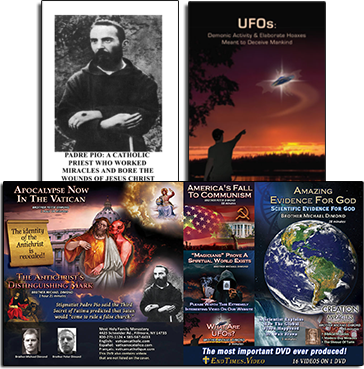
Thanks for the interest. Some people were very excited about the billboard we recently put up last summer in California (picture and description). Well, we were able to purchase that billboard for more than an entire month for only $3,500. That’s a tremendous deal when one considers that it’s on one of the most congested spots of one of the busiest highways in the country (the 405), where an estimated 723,000 people see the billboard each week. That deal (or one that’s essentially equivalent) might be available to us in the future as well. There are unsold remnant billboard spots available all over the country that can be purchased. It was the first time we ever ran a billboard. However, almost all of our outreach has been in other areas. Over the last around nine years we have run numerous national TV ads, national radio ads, internet ads, and direct mailings. Many people have found the true faith as a result of these and similar efforts. (In fact, many of the people reading this probably found our material as a result of one of those things.) We have also offered our material for extremely low prices so that people can easily give out free copies to others. For example, there are approximately 380,000 copies of the Padre Pio book in circulation. We only have about 20,000 copies left. We will need to do another large run of those books soon. We only have 5,000 copies left of the book on UFOs. That’s another book we will need to reprint.
We also want to thank those few true Catholics who have zeal to distribute our information and contribute in the most critical mission to help save souls. We continue (on a daily basis) to reach people with internet ads. In fact, millions have come to our website from our internet ads alone. We would like to run more national TV and radio ads, as well as billboards. Unfortunately, due to the amount of funding we receive (if something doesn't change this year), we will have to focus our advertising outreach only to certain areas. Therefore, the number of those who will find out about the crucial information we make available will be limited. Many people who have discovered our material are happy and satisfied that they have seen the truth. They like the information, but unfortunately they lack the zeal and the true charity to evangelize their family members, friends, people they run into, etc. Many of them don't distribute free DVDs (the 9 in 1 DVD is recommended for distribution to random individuals), give out the website or help us financially so that we could give others the opportunity to come to the knowledge of the truth. In other words, they use the information themselves but don't really do much or anything to help the cause. They are hearers of the word, not doers of the word (James 1:22). That's a primary reason that very few are saved (Matthew 7:13): i.e. they don’t really care about other people, but mainly about themselves. (Also, as we've mentioned numerous times in the past, if people are supporting any of the other groups which unfortunately embrace false positions or teach heresies - which is basically all of them - they will lose their souls.) So, we don't ask people who are struggling or in debt to help us, but people who have the financial ability and stability to do so. But if something doesn’t change dramatically in the very near future, we may be shutting down one of our 24 hour answering services. That's the answering service we have been using for our national TV and radio ads. If that happens, all possible future national TV and radio ads will end. And if that happens, we will most likely not be running any more billboards either.
Dear Brothers, I had a discussion which didn't end well with a protestant who happens to be my roommate for a period of 3 weeks. It concerned family planning. He holds that artificial family planning is not sinful. He also said that "it is sinful to give birth when you know you cannot take care of the child". It’s obvious he failed to realize that it is God who opens and shuts the womb and that a woman shall be saved "THROUGH" child bearing, even when I tried to prove that from Scripture. He lost complete trust in God and fails to realize the sinfulness of his position. When I brought up 1 Tim. 2:15, his version (the King James version) read: "she shall be saved 'IN' child bearing" instead of "THROUGH" child bearing. He argued that the verse teaches that a woman will be saved from death when giving birth if she perseveres in faith, love sanctification & sobriety (i.e. when IN is used). I told him that it may be a mistranslation in his version. I tried to give him example of some mistranslations in the KJV, like the one of John 3:36, but he wouldn't accept that because I could not provide the Greek version to prove that it is "THROUGH" not "IN". That is why I need your help on this. Looking forward to your response. May God bless your work.
PHILIP MONDAY
BRO. PETER DIMOND
Referring to “woman” (as mentioned in 1 Timothy 2:14), the Greek text for 1 Timothy 2:15 says “σωθήσεται” (she will be saved) “διά” (through/by means of) “τῆς τεκνογονίας” (the childbearing). In this verse “διά” clearly means “through” or “by means of.”
1 Timothy 2:15- “Yet she [the woman] will be saved through childbearing—if they continue in faith and love and holiness, with self-control.”
The Textus Receptus, the Greek text upon which the King James Bible was based, says the same.
Therefore, the Greek text clearly says that the woman will be saved “through” or “by means of” childbearing. (By the way, the English translation of 1 Tim. 2:15 in the King James Bible, which has “saved in childbearing,” was not necessarily a mistranslation. That’s because, as someone else pointed out, in the English used at the time the King James Bible was written, the preposition “in” had a wider application than it does in English today. At that time, the preposition “in” was commonly used to mean “by” or “by means of.” Regardless, the original Greek of 1 Timothy 2:15 says that “she will be saved through childbearing.”)
Obviously, this verse refutes Protestant theology in a number of ways. Many Protestants even admit that it’s an extremely difficult verse for them to understand. When confronted with 1 Tim. 2:15 in a debate, one Protestant did not even attempt to explain it. He simply said that “it’s quite mysterious.” Another well-known Protestant named William D. Mounce stated concerning the verse: “V 15 is certainly one of the strangest verses in the New Testament.” (Pastoral Epistles, Nashville: Thomas Nelson Publishers, 2000, 143.)
They find it troubling, mysterious, and strange simply because it completely contradicts their false theology. First, by teaching that a woman must continue in faith and holiness to be saved, it clearly teaches that someone who has the faith (i.e. a justified Christian) could lose salvation. That refutes the idea of once saved always saved. Second, by teaching that a woman’s actions will be a factor in whether she attains salvation (and therefore whether she maintains justification), the verse refutes the idea of justification by faith alone.
The Bible teaches that women are saved through childbearing because, for most women, fulfilling their state of life as wives and mothers, in accordance with the true faith, is what they must do in order to be saved. By fulfilling their state of life they will be saved – “if they continue in [true] faith and love and holiness, with self-control.” The verse also emphasizes the importance of being open to children – a powerful reminder of how God condemns all forms of birth control. That vexes Protestants as well, for almost all modern Protestants accept or practice some form of birth control. Protestants’ acceptance of birth control is another clear proof that they don’t have the true Christian faith. Here are two videos which demonstrate how both the Bible and the Catholic Church forbid all forms of birth control under pain of mortal sin.
Since the person with whom you are conversing seems to be inclined to King James Onlyism, he should definitely see this video. It covers a number of very important matters relevant to the history of the King James Bible, Bible translations, and the text of Scripture.
… I recently read some of the post in your website and I have started it when I found a video in YouTube entitled Is the World about to End? And after that I tried to read interesting topics on your site. By the way, I was raised as a Catholic when I was young but I am not sure what kind I belong to since I’ve read that there's a traditional and new one (I am not that familiar with all the technicalities, sorry about that). Again, I was raised as a Catholic but I’ve been missing church masses for some reasons. One of the reasons is the one I am about to tell you. Anyway, I have written this, and I've been meaning to ask this particular question to any Catholic member since it has been a looming over me for a very long time - is there any passage in the Bible that pertains to adoration (I'm not sure of the word I’ve use because I don't want to use the word worship) of religious images and sculptures. Do you have any video on it that clearly answers and explain this one?
Most of the Catholic churches I've been to in our country have this, on varying sizes and kinds.
I have this feeling inside me, that it is wrong, and most of the times it really creeps me out especially the big ones. It felt like believing in these man-made statues is like idolatry stated in Exodus. Many people go to them, kneel and pray for them, take care and dress them, and wipe their towels over them as if it would perform a miracle of some sorts. Most of the Catholics said it is mere representation of whom we pray for but (I would contest) Jesus did not bow his head to any statues just to pray to our Father or any man before him, so why do people need to do it now. It felt like this practice has been misleading us. Correct me if I am wrong to think of this matter.
My mother has few of these statues at home (Sto. Ninos, Mother Mary) and lately it bothers me… I hope you could clarify to me about your stand on religious images and statues, looking forward to it.
Thank you very much.
God Bless.
Sincerely yours,
Rheyan L
MHFM: We’re glad that you came across the material. No, adoration of the Blessed Sacrament is completely Christian. However, Jesus Christ is not present in the Novus Ordo, as our material explains. Your problem on the issue arises because you are not convinced of Catholic teaching on the Eucharist. A properly consecrated Eucharist is the Body, Blood, Soul and Divinity of Jesus Christ. That’s very clear from the teaching of Jesus Christ and the Bible (see John chapter 6). It was held by the entire early Church. Therefore, the Eucharist should be adored. Your position is inconsistent with that truth of Christianity. You need to see our book, The Bible Proves the Teachings of the Catholic Church. It has a section on the overwhelming biblical proof for Catholic teaching on the Eucharist.
With regard to images and statues, your position is not correct.
First, what God forbids and condemns is the adoration of statues/images themselves, and the making of statues/images of idols and false gods.
Deuteronomy 5:8-9- “You shall not make to thyself a graven thing, nor the likeness of any things, that are in heaven above, or that are in the earth beneath, or that abide in the waters under the earth. You shall not adore them, and you shall not serve them.…”
Notice that God says: you shall not adore them or serve them. That’s the key. He forbids making statues or images to adore them or to adore idols, creatures, false gods, etc. But He does not forbid using religious statues or images in His true faith and religion. In fact, He commanded religious statues to be made for his temple and they are approved in numerous places in the Bible.
Exodus 25:18-19- “And you shalt make two cherubim of gold,of beaten work shalt you make them, in the two ends of the mercy seat. And make one cherub on the one end, and the other cherub on the other end: even of the mercy seat shall you make the cherubim on the two ends thereof.”
God specifically commands the making of two statues of cherubim. Cherubim are angels. This obviously refutes the idea that making statues or using religious images is forbidden. Such an idea is a total misrepresentation of the teaching of Sacred Scripture, which forbids them with reference to the idolatrous adoration of creatures, idols and false gods. Other passages in the Bible where we see references to God’s command to make statues for true religious purposes are: Exodus 26:1; 1 Kings 6 (3 Kings 6 in some versions); and 1 Kings 7:25-36 (3 Kings 7:25-36 in some versions).
We also find God commanding the use of an image to cure people – an image which, at first thought, some would find surprising. God commanded Moses to make an image of a serpent for the people to look upon and be healed.
Numbers 21:8- “And the Lord said unto Moses, make thee a fiery serpent, and set it upon a pole: and it shall come to pass, that every one that is bitten, when he looks upon it, shall live.”
Third, when Catholics honor an image, trust is not placed in the image itself. Rather, we honor the one represented by the image by means of the image.
Council of Trent, Sess. 25, Decree on Sacred Images: “Moreover, that the images of Christ, of the Virgin Mother of God, and of the other saints are to be placed and retained especially in the churches, and that due honor and veneration is to be given them; not, however, that any divinity or virtue is believed to be in them by reason of which they are to be venerated, or that something is to be asked of them, or that trust is to be placed in images, as was done of old by the Gentiles who placed their hope in idols;but because the honor which is shown them is referred to the prototypes which they represent, so that by means of the images which we kiss and before which we uncover the head and prostrate ourselves, we adore Christ and venerate the saints whose likeness they bear. That is what was defined by the decrees of the councils, especially of the Second Council of Nicaea, against the opponents of images.”
The Bible also teaches that even the relics of saintly people are venerated and can be miraculous. See Acts chapter 19:11-12 concerning the miraculous handkerchiefs of St. Paul, and 2 Kings 2:13-14 concerning the miraculous cloak of Elijah.
Acts 19:11-12- “And God wrought special miracles by the hands of Paul: So that from his body were brought unto the sick handkerchiefs or aprons, and the diseases departed from them, and the evil spirits went out of them.”
2 Kings 2:13-14- “He picked up the cloak that had fallen from Elijah and went back and stood on the bank of the Jordan. Then he took the cloak that had fallen from him and struck the water with it… When he struck the water, it divided to the right and to the left, and he crossed over.”
So, the Catholic position on the proper use of religious images, statues and relics is not contrary to the Bible. It is the truly biblical view.
Moreover, you mention that you were raised a ‘Catholic.’ You were actually raised in the Vatican II sect. That’s not the true Catholic Church. It doesn’t teach or represent the true Catholic faith. Its New Masses are invalid and the sect is empty. That’s a big reason why you and so many others were not inclined to be more interested in what it has to ‘offer.’ It’s crucial that you consult the material on our site, pray 15 decades of the Rosary each day, and take the steps to embrace the traditional Catholic faith.
For more, see our book The Bible Proves the Teachings of the Catholic Church, our Refuting Protestantism section and our future materials on these matters.
This is a billboard we are currently running on one of the busiest highways in the country (Interstate 405). It’s right outside Los Angeles, CA. The billboard started on July 10, 2014. It’s estimated that 723,000 people see the billboard each week. Donations can help us put up more billboards across the country so that people find the truth.
Subject: Spotted
Dear Brothers,
I was driving down the 405/110 freeway in Los Angeles CA when I spotted a billboard with your web address. I so so pleased to see it. California is experiencing such demonic actions… The people need to know the truth. Thank you for your time.
GOD bless you and the work you do.
Maria Reed
Subject: I saw one of your signs off of the 405 Fwy in CA!
Dear Dimond Brothers –
I was very happy to see your signage. I hope people will go to your website. I think it was easily viewable from the Southbound 405.
My husband and I know and agree with the information you have provided and I want to thank you for making available the truths about what the Catholic Church really teaches and preaches, especially regarding Baptism. Last fall, I became pregnant for the eleventh time, and shortly after discovering the pregnancy, I started bleeding heavily. I thought I had lost the baby, but I was wrong. I started offering our daily rosary for the intention that God would allow my child to live long enough to be born and baptized (knowing how important Baptism is). Shortly afterwards, my bleeding and cramping went away and I thought that our new son was growing and developing normally. Early in April, we found out that our baby had a fatal heart defect. His heart became so enlarged that there was no room for his lungs to develop normally. I renewed my request, this time invoking Jesus, Mary as well as Joseph, asking that God would allow my baby to be born alive so he would have a chance to be baptized. Our prayers were answered this past weekend, with our newest son, Matthew George Roy being born on the morning of May 10. My husband baptized him immediately, and right after the baptism, the nurse told me that his heart had just quit. Looking at our son, knowing how bad his heart was and that he had virtually no lung tissue to breathe with, it was a miracle that he did not die before he was born. Both the doctor and nurse told me that his heart was beating at the time of his baptism. God kept him alive until he could be baptized, then He took him to heaven. Please don't stop teaching and telling people the grave importance of water baptism, for if desire were sufficient to attain eternal life, God would have taken our son last winter.
Your videos and audios are a welcome change from the garbage one is normally exposed to on the radio, TV and computer. I am looking forward to listening to your past and future videos and audios.
On Jan. 1 Francis urged people to accept each other’s differences and for enemies to recognize that they are brothers — a New Year’s Day service dedicated to world peace. “We are all children of one heavenly father, we belong to the same human family and we share a common destiny,” Francis said, speaking from his studio window overlooking St. Peter’s Square, jammed with tens of thousands of faithful, tourists and Romans. “This brings a responsibility for each to work so that the world becomes a community of brothers who respect each other, accept each other in one’s diversity, and take care of one another,” Francis said.
This is contrary to Catholic teaching. Not all men are children of God. Antipope Francis clearly doesn't have the first clue about Catholic teaching. Two quotes suffice to prove the point. More could be given.
Pope Leo XIII, Satis Cognitum (# 16), June 29, 1896: “Let such as these take counsel with themselves, and realize that they can in no wise be counted among the children of God, unless they take Christ Jesus as their Brother, and at the same time the Church as their mother.”
Pope Leo XII, Ubi Primum (# 22), May 5, 1824: “In reference to these words St. Augustine says: ‘Whoever is without the Church will not be reckoned among the sons, and whoever does not want to have the Church as mother will not have God as father.’”
While his assertion that all are children of God is not necessarily Antipope Francis' worst heresy, he does teach it repeatedly. In doing so he creates the impression that God accepts all men and casts no one out from His blessings or salvation. It implies universal salvation.
Hello, this is both hard and embarrassing for me to write this. Since late 2007 I have been a sex addict. I know a lot of people might think this is funny, but it is nothing to laugh at. I have fornicated with a lot of women since 07 to this present day. I don't consider myself an evil person, actually I consider myself a good person that just happens to be suffering from this sex addiction. I thought of getting some therapy but I don't have the money to afford it. I hope you at the MHFM can give some advice on how to overcome this addiction.
MHFM: You use the term “addiction” with the implication that you are a victim who is not responsible for your activity. No, your behavior is mortally sinful. It’s a diabolical addiction – one which arises from your own choices and refusal of God’s grace. In charity and in the interests of your salvation, we must inform you that you are not a good person, but a bad one.
However, there are a few simple remedies to your problem: First, avoid the occasions of your sin. Take drastic measures in this regard, if necessary. For example, if your fornication occurs at a particular place, stop going to that place at all costs. Or if your computer is the genesis of your sin – it shouldn’t be, but if you are continually falling into mortal sin as a result of it – get rid of it. That’s what Jesus means in Matthew 5:29-30, when He says:
“And if thy right eye scandalize thee, pluck it out and cast it from thee. For it is expedient for thee that one of thy members should perish, rather than that thy whole body be cast into hell. And if thy right hand scandalize thee, cut it off, and cast it from thee: for it is expedient for thee that one of thy members should perish, rather than that thy whole body be cast into hell.”
It’s not a surprise that Jesus makes these statements, about cutting things off, just one verse after saying, in Mt. 5:28: “But I say to you, that whosoever shall look on a woman to lust after her, hath already committed adultery with her in his heart.” Obviously taking drastic measures to cut off sinful occasions has a particular application to people who fall into sexual sins.
For those who don’t know, the mortal sins that are sexual in nature, which place a person in a state of damnation, include, among other things, acts of fornication, the sexual acts which precede or lead up to fornication, adultery, masturbation, looking at pornography, giving full consent to impure thoughts, etc. (See our series, Rejecting the Lust and Impurity of Hell, for more on this topic).
Second, you need to pray the Rosary each day. Your problem is a spiritual one and will not be solved without prayer, the aid of God’s grace, and the proper spiritual remedies. Praying to God and cultivating a devotion to the Blessed Virgin Mary, the Hail Mary and the Rosary is essential. And, of course, if you don’t have the true Catholic faith, you need to convert to it. (The steps to do so are on our website.)
Third, and this is very important, begin (by the grace of God) to exercise your will and fear God. Though it might sound simple, this point actually cuts to the heart of your problem. You need to simply determine or resolve, by God’s grace, that you are not going to commit the sin anymore. In this regard, the following quote is relevant:
St. Alphonsus (1760): “If you neglect God’s call on this occasion, he may perhaps abandon you forever. Resolve, then, resolve! ‘The devil,’ says St. Theresa, ‘is afraid of resolute souls.’ St. Bernard teaches that many souls are lost through want of fortitude.”
That is to say, souls lacking determination or courage or, you might say, a certain degree of toughness will not be saved. Many people are lost because they are simply too weak, too compliant, too wimpy. They acquiesce; they give in; they submit – whereas others say NO. Mortal sinners engage in things which, if they simply exercised their will, they could reject without much difficulty.
When people do take the firm steps to reject sin or cut off mortally sinful occasions – while they might find it difficult at first, which is the time when God usually allows them to be most challenged – if they overcome the initial hurdle, after a very short period of time they realize that what they previously found difficult is not difficult at all. They find the statement, “out of sight out of mind,” to be a true one and refreshing one.
For instance, in regard to being determined or resolved, truly you could stop going to the place where you commit the mortal sin, but you don’t want to. Hence, you are on the road to damnation. This lack of fortitude or determination is responsible for the damnation of many souls. This truth, about the importance of possessing a certain measure of fortitude – the ability to simply say: no, I will not do this – not only has application to the spiritual life, but also to doctrinal matters and to teaching God’s truth. For this reason, people who lack fortitude or toughness should not become priests or be engaged in teaching others the truths of God. For when people who are unwilling, unable or uninclined to be combative, to refuse people, to offend people, and yes, to condemn people – when those individuals attempt to deal with or teach God’s truths, they will undoubtedly compromise those truths in order to please others. In the same way, in the spiritual life, people who can’t say “no,” and take decisive action in this regard when required, will give in to mortal sin and be damned.
Ultimately, your willingness to commit clear mortal sins arises from your lack of humility: in your pride you don’t have the requisite respect for God’s laws and the necessary fear of the punishment He can and will mete out for such behavior. You think God is a joke. You think you can engage in activity He has specifically forbidden, turn others into little more than the object of your fleeting, empty pleasures, and then claim victimhood on top of it.
Galatians 6:7-8- “Be not deceived, God is not mocked. For what things a man shall sow, those also shall he reap. For he that soweth in his flesh, of the flesh also shall reap corruption. But he that soweth in the spirit, of the spirit shall reap life everlasting.”
Deuteronomy 32:35- “Revenge is mine, and I will repay them in due time, that their foot may slide: the day of destruction is at hand, and the time makes haste to come.”
We also often find that people like you, in a sad attempt to justify their sins, look to others to solve their problem. Your inclination to look to others for the solution, rather than to yourself, i.e., to the simple means God has placed solely at your disposal, is similar to how people who fall into sins of impurity are often fixated on blaming their impurity on the immodesty of dress exhibited by others. While grave immodesty of dress is clearly a sin, it’s no excuse for people to fall into impurity. Giving full consent to impure thoughts or desires is a grave sin, regardless of what is put in front of a person. People need to have, by the grace of God, the internal purity, force of will, and self-control that they do not give full consent to impurity even if they happen to be exposed to highly inappropriate things through no fault of their own. For instance, many missionaries preached to natives who were naked or almost completely naked. That was not an occasion or justification for falling into impurity, as they had, by God’s grace, the internal purity, self-control and desire for that which is natural and pure, to say no to lust and wickedness, both internally and externally.
In regard to your lack of humility being the root cause of your problem, the following quote is relevant:
St. Benedict (c. 520): “The first degree of humility, then, is that a man always have the fear of God before his eyes, shunning all forgetfulness and that he be ever mindful of all that God hath commanded, that he always considereth in his mind how those who despise God will burn in hell for their sins, and that life everlasting is prepared for those who fear God.”
The first degree of humility, which you lack at this time, involves the recognition and fear of God: that He will condemn you to burn in Hell for your sins. “The fear of the Lord is the beginning of wisdom…” (Psalm 110:10). It should motivate you to action in this regard.
So, the solution to your problem, along with God’s forgiveness – which should entail a valid sacramental confession once a person is prepared – is there for you if you take these simple steps. But if you don’t, you should consider the following words:
St. Alphonsus on the damnation of the impure: “Continue, O fool, says St. Peter Damian (speaking to the unchaste), continue to gratify the flesh; for the day will come in which thy impurities will become as pitch in thy entrails, to increase and aggravate the torments of the flame which will burn thee in hell: 'The day will come, yea rather the night, when thy lust shall be turned into pitch, to feed in thy bowels the everlasting fire.’”
1917 Pio Benedictine Code of Canon Law Canon 1366 (2) Professors shall treat studies in rational theology and philosophy and the instruction of students in these disciplines according to the system, teaching, and principles of the Angelic Doctor (St. Thomas Aquinas) and hold to them religiously.
St. Thomas Aquinas..... "THE SACRAMENT OF BAPTISM IS SAID TO BE NESSESARY FOR SALVATION IN SO FAR AS THERE CAN BE NO SALVATION FOR MAN UNLESS HE AT LEAST HAVE IT IN DESIRE WHICH, WHICH WITH GOD, COUNTS FOR THE DEED." (Summa Theologica 3, 68 2 )
According to you St. Thomas is burning in hell. Clearly one would be in Grave error in two ways by obedience and condeming a Saint to hell, to deny these facts one would be lying to yourself and to God.
In Charity.... jmak
MHFM
You are so wrong. First, we don’t believe that St. Thomas was a heretic. We believe he was wrong. Many saints and doctors have been wrong, as our material proves. If you knew anything about Catholicism, you would know that. For you to say that we believe he was a heretic and is burning in Hell is a lie and a mortal sin.
Second, you are refuted by St. Thomas himself. Allow me to explain. You argue that the Church teaches that St. Thomas must be followed, and that St. Thomas teaches baptism of desire. Therefore, according to your argument, baptism of desire must be accepted. But you are quite wrong. St. Thomas teaches that he should NOT be followed if he contradicts something that the Church itself has taught.
St. Thomas Aquinas, Summa Theologica, Pt. II-II, Q. 10, A. 12: “The custom of the Church has very great authority and ought to be jealously observed in all things, since the very doctrine of Catholic doctors derives its authority from the Church. Hence we ought to abide by the authority of the Church rather than by that of an Augustine or a Jerome or of any doctor whatever.”
So, let’s apply your argument logically: we must follow St. Thomas, but St. Thomas says that we must not follow any doctor if he advances something which contradicts the authority of the Church. Therefore, by following St. Thomas, we find that we are not required to accept every opinion he held or everything he taught. This should be obvious, but this quote is important in proving the point and refuting heretics such as yourself. Since he contradicts statements of greater weight from the papal magisterium on the absolute necessity of water baptism, we are not required to follow St. Thomas in his flawed opinion concerning “baptism of desire.” Likewise, we are not required to follow his other opinions that might have contradicted teachings of greater weight. For example, St. Thomas also contradicted the Immaculate Conception, as we see here:
St. Thomas Aquinas, Summa Theologica, Pt. III, Q. 27, A. 2, Reply to Objection 2: “If the soul of the Blessed Virgin had never incurred the stain of original sin, this would be derogatory to the dignity of Christ, by reason of His being the universal Saviour of all. Consequently after Christ, who, as the universal Saviour of all, needed not to be saved, the purity of the Blessed Virgin holds the highest place.”
St. Thomas Aquinas, Summa Theologica, Pt. III, Q. 27, A. 2, Reply to Objection 3. “Although the Church of Rome does not celebrate the Conception of the Blessed Virgin, yet it tolerates the custom of certain churches that do keep that feast, wherefore this is not to be entirely reprobated. Nevertheless the celebration of this feast does not give us to understand that she was holy in her conception. But since it is not known when she was sanctified, the feast of her Sanctification, rather than the feast of her Conception, is kept on the day of her conception.”
According to your heretical argument, these statements must be consistent with Catholic teaching. According to you, they are not only true but should be believed and taught to all! The truth, however, is that they were false during his time, and they are heretical now. They contradict the dogma of the Immaculate Conception. This is further proof that your argument is utterly false and that you corrupt Catholic principles.
Pope Benedict XIV, Apostolica (# 6), June 26, 1749: “The Church’s judgment is preferable to that of a Doctor renowned for his holiness and teaching.”
Pope Pius XII, Humani generis (# 21), Aug. 12, 1950: “This deposit of faith our Divine Redeemer has given for authentic interpretation not to each of the faithful, not even to theologians, but only to the Teaching Authority of the Church.’”
[I have been arguing with someone] Before I held your position, that he was a Pope, but now I am unsure and do not know what to say, this is what he wrote to me,
"No, a pope cannot teach heresy in his fallible documents! Why would you believe that unless you follow the Dimonds? So according to your position, as long as the pope does not intend to bind the faithful to his teachings, he can be a heretic! Why was John XXIII an antipope then? Answer me that one right now."
"I have another question for you, in addition to the John XXIII question. If a pope does not lose office for teaching heresy in his fallible capacity, then do you not give lip service only to the dogma that heretics are outside the Church? Or do you assert that a heretic who is outside the Church can still be pope, so long as he doesn't try to bind all the faithful and invoke infallibility for his heresy? Finally, if what you say is true, then how many heresies can a pope teach in his fallible capacity? Can he teach one and still be pope? Seven? Seventy times seven?
"You and they both believe that a pope can teach heresy in his fallible capacity, essentially equating the dogma of infallibility with protecting a pope from uttering heresy while binding the whole Church. It is so much more than that. It means that whatever they utter ex cathedra is completely true, yet you and the Dimonds only give lip service to this reality, as most people do. And as a result of this you believe that a pope can utter heresy in his fallible capacity, and that he would still be pope."
What are one to say to such questions. It just seems to be that Pius XII was a heretic, does it not? Please, if you could shed light on this for me would be much appreciated! Thanks and God bless.
Regards,
V. Veikko
MHFM
His entire line of argumentation is a straw man – that is, attributing to another a position he doesn’t actually hold. We don’t believe that someone who is a heretic in his fallible capacity remains the pope. We don’t say that. Since they cannot refute the position, they must use straw-man argumentation. No heretic can remain the pope, even if he only teaches the heresy in his fallible capacity. (A true pope could never teach heresy in an infallible capacity, of course.)
The point is that there isn’t sufficient evidence to definitely conclude that Pius XII was a heretic, rather than someone who was a terribly weak pope who made doctrinal errors. That’s because the errors which Pius XII taught were not specific propositions which have been explicitly condemned by the Magisterium by name. Rather, they are proven to be false and incompatible with Catholic teaching by the positive dogmatic statements on related subjects. As a result, these errors become heresies once one puts together (or can be shown to be directly obstinate against) all of the positive dogmatic evidence which contradicts them. That doesn’t mean that someone doesn’t sin for promoting them and neglecting to more carefully consult Catholic teaching. It is simply to point out that there is a difference, from the standpoint of manifest heresy, between the promotion of such an error and the promotion of something that has been explicitly and notoriously condemned by name in a dogmatic decree (e.g., Justification by faith alone).
In fact, notice that in the following decree of the Council of Constance, there is a distinction between propositions that are offensive to Catholic teaching, etc. and those which are notoriously heretical. They are “notoriously heretical” because they have previously been condemned by the Magisterium by name, in a manner which should be obvious to all. This proves that notoriety is not simply reserved for how one promotes a falsehood, but also THE SPECIFIC FALSEHOOD ITSELF (i.e., how clearly and obviously has it been condemned by the Church). This coincides precisely with what we’ve said about certain undeclared heretical priests. We’ve pointed out (correctly) that how notorious they are is not only dependent upon how they promote something, but also dependent upon the content of the falsehood they embrace.
Council of Constance, Sess. 15, July 6, 1415, Sentence against John Huss: “This most holy Synod of Constance therefore declares and defines that the articles listed below, which have been found on examination, by many masters in sacred scripture, to be contained in his books and pamphlets written in his own hand, and which the same John Huss at a public hearing, before the fathers and prelates of this sacred council, has confessed to be contained in his books and pamphlets, are not Catholic and should not be taught to be such but rather many of them are erroneous, others scandalous, others offensive to the ears of the devout, many of them are rash and seditious, and some of them are notoriously heretical and have long ago been rejected and condemned by holy fathers and by general councils, and it strictly forbids them to be preached, taught or in any way approved.”
MORE ON PIUS XII AND HERESY
Hello Dimond Brothers,
I just had some questions regarding the recent post you made about "Pius XII and heresy": You say that "there isn’t sufficient evidence to definitely conclude that Pius XII was a heretic" when you yourself say in your book (Outside the Catholic Church there is absolutely no salvation) the following:
"Pius XII was by no means a staunch traditionalist. His reforms, omissions and failures paved the way for Vatican II. Just a few things that Pius XII did are:
- He promoted Annibale Bugnini, the author of the New Mass, and began the liturgical reform with his allowance of reforms in the Holy Week Rites. A good number of liturgical scholars think that the reforms of Holy Week were terrible. One example is the allowance of distribution of Holy Communion on Good Friday. The decree of the Holy Office under Pope Pius X On Frequent Communion cites Pope Innocent XI who condemned such a practice.
- He promoted men like Giovanni Montini (later Paul VI) and Angelo Roncalli (later John XXIII), without which promotions these men could never have had the influence or caused the immeasurable destruction that they did. - He said that theistic evolution could be taught in Catholic schools (Humani Generis, 1950), which is nothing short of ludicrous – and arguably heretical.
- He taught that birth control could be used by couples by means of the rhythm method (or Natural Family Planning), which is a frustration and a subordination of the primary purpose of the marriage act – conception.
- He allowed the persecution and subsequent excommunication of Father Leonard Feeney, whether through willful complicity or neglect, for doing what every Catholic priest should do: preach the Gospel, defend the faith and adhere to defined dogma."
Now, if all of these things that you listed are not "sufficient evidence to conclude that Pius XII was a heretic", a man that you claim "paved the way for Vatican II", then what is? I even heard from someone that he was a Mason, along with Benedict XV (15) and Pius XI (haven't confirmed it yet). He also said in a speech that adults can be saved without the Sacrament of Baptism. Now to the real problems:
- It is a solemnly defined dogma that the Sacrament of Baptism is absolutely necessary for salvation, without exceptions, (Council of Trent, Florence, etc.) as you very well know - Pius XII said that adults can be saved without it - Heresy.
- You hold that NFP is infallibly condemned in Pius XI's infallible Encyclical Casti Connubbi - Pius XII explicitly taught NFP - Heresy. - He said that theistic evolution could be taught in Catholic schools, and also was on both sides regarding evolution - something you yourself say is heretical. Now, you then say "the errors which Pius XII taught were not specific propositions which have been explicitly condemned by the Magisterium by name. Rather, they are proven to be false and incompatible with Catholic teaching by the positive dogmatic statements on related subjects."
This is clearly false, and a specious lie. As mentioned above: - That the Sacrament of Baptism is necessary for salvation without exceptions, and that the ones who die without it can go to Heaven, the former has been dogmatically defined many times, and the latter has been dogmatically condemned by name as well - Pius XII taught that adults can be saved without the Sacrament of Baptism, which is heretical.
- You say that NFP was infallibly condemned in name by Pope Pius XI - Pius XII taught it, which is heretical. And you can't argue that Pius XII was "unfamiliar" or "unaware" of all these teachings, that's absurd, because Pius XII was a cleric: "If the delinquent making this claim be a cleric, his plea for mitigation must be dismissed, either as untrue, or else as indicating ignorance which is affected, or at least crass and supine…His ecclesiastical training in the seminary, with its moral and dogmatic theology, its ecclesiastical history, not to mention its canon law, all insure that the Church’s attitude towards heresy was imparted to him." (McDevitt, 48.)
And, seriously, are you really going to argue that, that adults can't be saved without the Sacrament of Baptism, "evolution", and NFP, have not been notoriously condemned??? I'm afraid you're again (you have done this before) guilty of raising the bar as to what constitues a heresy, what is heretical and when does a Pope lose his office, you do this when you don't want to accept the outcome. You gotta be honest here, something you yourself recommend. There was also another point I wanted to make: Pope Honorius I was condemned as a heretic for "supposedly" having held/supported the monophysite heresy; I have read that they weren't even sure if he was a heretic 100% or not (St. Francis de Sales certainly wasn't sure), or if he even held the heresy.
Now, if they condemned him for apparently having been a heretic, what would they say about Pius XII, who taught explicit and open heresy (among all the other things he did/didn't do)???
The way I see it, the same reasons why you would consider John XXIII as an antipope, you would also consider Pius XII, and perhaps Benedict XV (15) as well. But with all that said, I myself haven't decided to believe if Pius XII or Benedict XV (15) really were antipopes, but the evidence sure seems to suggest they were. How do you reply?
MHFM:
There are numerous errors in your very dishonest, illogical and inaccurate e-mail. Since people such as yourself have already been refuted in audios, etc., I’m not going to spend a lot of time with you. I will quickly refute your main errors, however. To your first lie:
>>>>"[quoting us] the errors which Pius XII taught were not specific propositions which have been explicitly condemned by the Magisterium by name. Rather, they are proven to be false and incompatible with Catholic teaching by the positive dogmatic statements on related subjects." [You write] This is clearly false, and a specious lie. >>>
No, it's not a lie. You are the heretical and contradictory liar, as I will show. We are talking here about the idea of explicit baptism of desire. The theory of explicit baptism of desire is a horrible error. We have pointed this out more than anyone. This horrible error becomes a heresy once one sees all of the positive dogmatic evidence which contradicts it. However, this idea (i.e., explicit baptism of desire) hasn’t been condemned by name. Someone could be confused about the issue or hold it in good faith until all of the dogmatic evidence is pointed out to him and the objections raised in its favor are refuted. To obstinately express belief in it after that time is to demonstrate bad will and to depart from the faith. Therefore, explicit baptism of desire is proven to be incompatible with Catholic teaching by the positive evidence. For you to say that it has been explicitly condemned by name is dishonest. So, what we’ve already written refutes you.
Moreover, you condemn yourself in your own e-mail. That’s because if you really believe what you write, you would have to say that Pius XII was definitely a heretic and therefore an antipope. Instead, you say that you don't know if he was a heretic:
You write<<<<But with all that said, I myself haven't decided to believe if Pius XII or Benedict XV (15) really were antipopes>>>
You are condemned by your own words. Your whole e-mail purports to show that he was a heretic. You thus prove yourself to be a contradictory liar. You aren’t even convinced that he was a heretic! That means that you don't really believe what you write. Get out of here, you phony. Don’t act like you believe something that you don’t. Moreover, if anyone who affirms explicit baptism of desire even once is ipso facto to be considered a heretic, then that means you would have to say that St. Alphonsus and St. Robert were heretics. There is no way around that argument. They believed in explicit baptism of desire. They were dead wrong, of course; and to obstinately hold their erroneous position in the face of all the dogmatic evidence does show bad will. However, it is not ipso facto a proof of manifest heresy. If you don't admit that they and everyone who expresses belief in it even once is to be considered a heretic, then you condemn yourself again. If you do, then you further prove yourself to be a non-Catholic; for in that case you must condemn the Catholic Church itself for canonizing those you deem to have been manifest heretics. By the way, have some courage and put your real full name.
To your next lie, you write:
>>>You say that NFP was infallibly condemned in name by Pope Pius XI - Pius XII taught it, which is heretical.>>>
We don’t say that Pius XI infallibly condemned it “in name.” He did not. We say that it’s proven to be incompatible with the infallible Catholic teaching on the primary purpose of the marriage act. Thus, you dishonestly misrepresent what we say. Please quote the passage where NFP is explicitly condemned by name. You cannot do so because it doesn’t exist. Rather, it’s proven to be wrong by the positive evidence, just as we said.
Regarding Pius XII and theistic evolution, we agree that it’s horrible, awful, atrocious. There are only two things which we believe save him from manifest heresy on this point (though not from mortal sin and grave error). Those are 1) the fact that it hasn’t been explicitly condemned in any dogmatic decree. It’s definitely false and certainly runs counter to the obvious teaching of Scripture and the whole history of Catholic thought. However, it is not proven to be heretical by virtue of a specific condemnation by a dogmatic decree. That holds significance for point #2.
2) The fact that Pius XII didn’t say that he believed in it. He said that it may be taught. Thus, one could arguably justify him from manifest heresy (though not from mortal sin and scandal) by arguing that, even though he personally didn’t believe in it, he labored under the false impression that he couldn’t forbid people to teach it if it hasn’t been condemned in a dogmatic decree. That’s the only thing that we believe saves him from manifest heresy on this point. In fact, if you read what he said about it, you can see in that very context that he forbids people from teaching only those things which he believes to have been clearly condemned by the teaching of dogmatic councils or by a specific statement of the papal magisterium.
To your next statement, which truly expresses your schismatic mentality, you write:
>>>I even heard from someone that he was a Mason, along with Benedict XV (15) and Pius XI (haven't confirmed it yet).>>>
We’ve heard many unflattering things about Pope Pius XII. But hearing things, and having clear proof for them, are two different things. Hearing things about someone doesn’t allow us to conclude that a true pope is an antipope. The fact that you argue that it does reveals that you have a schismatic – not a Catholic – way of operating. You also ask: what would he have to do? I could give many examples. If he clearly taught (more than once, so that we know it wasn’t an editorial error) that souls can be saved in non-Catholic religions, he would have to be considered a manifest heretic. But not only is that not the case, his official teaching in Mystici Corporis contradicts that heresy. It also contradicts any notion of salvation without the Sacrament of Baptism. One can effectively use it to disprove the baptism of desire crowd of apostates.
Pope Pius XII, Mystici Corporis (# 22), June 29, 1943: “Actually only those are to be numbered among the members of the Church who have received the laver of regeneration and profess the true faith.”
Pope Pius XII, Mediator Dei (# 43), Nov. 20, 1947: “In the same way, actually that baptism is the distinctive mark of all Christians, and serves to differentiate them from those who have not been cleansed in this purifying stream and consequently are not members of Christ, the sacrament of holy orders sets the priest apart from the rest of the faithful who have not received this consecration.”
Pope Pius XII, Humani Generis (#27), 1950: “Some say they are not bound by the doctrine, explained in Our Encyclical Letter of a few years ago, and based on the sources of revelation, which teaches that the Mystical Body of Christ and the Roman Catholic Church are one and the same. Some reduce to a meaningless formula the necessity of belonging to the true Church in order to gain eternal salvation.”
With regard to Pius XII paving the way for Vatican II, that also doesn’t prove that he was without question a heretic. In his fallible capacity, a bad pope can attempt to hurt the Church. He can do this by omissions, bad reforms, and weak statements which don’t rise to the level of manifest heresy. That’s precisely why St. Robert Bellarmine speaks of a true pope who tries to destroy the Church. We quote this passage not because in itself it proves the true position; but rather because it lends further support to the correct Catholic understanding of this issue, which I have been articulating. Bellarmine is talking about a bad pope. He says that you may resist such a pope. In other words, there could be a true pope who tries to destroy the Church. He could do this in ways that don’t rise to the level of clear-cut manifest heresy.
St. Robert Bellarmine, De Romano Pontifice, Book II, Chap. 29: “Just as it is licit to resist the Pontiff who attacks the body, so also is it licit to resist him who attacks souls or destroys the civil order or above all, tries to destroy the Church. I say that it is licit to resist him by not doing what he orders and by impeding the execution of his will. It is not licit, however, to judge him, to punish him, or to depose him.”
But when speaking of a clear-cut manifest heretic, St. Robert clearly says that such a one ceases to be the pope.
St. Robert Bellarmine, De Romano Pontifice, chapter 30: “A pope who is a manifest heretic automatically (per se) ceases to be pope and head, just as he ceases automatically to be a Christian and a member of the Church. Wherefore, he can be judged and punished by the Church. This is the teaching of all the ancient Fathers who teach that manifest heretics immediately lose all jurisdiction.”
As an aside, countless false traditionalists cite the former passage but dishonestly do not cite the latter.
To your final error, you don’t understand the Honorius case. The councils which condemned him (e.g., Constantinople III) didn’t express any uncertainty. They didn’t condemn him because they believed he was “apparently” a heretic. Rather, they condemned him as an outright heretic because they believed he was an outright heretic. The confusion arose after the council – not within the actual statement of the council. In confirming the Third Council of Constantinople, Pope St. Leo II made a statement which some interpreted to mean that the condemnation of Honorius should only be accepted in the sense that he enabled heresy to flourish. However, that’s speculative. That’s why St. Francis De Sales was unsure whether Honorius was a heretic. The uncertainty concerning Honorius wasn’t expressed in the text of the council itself.
In conclusion, we have repeatedly discussed why a traditional Catholic must be aware of the fact that Pius XII was not a strong pope. He was probably about as close to heresy as a pope could be without being a clear-cut manifest heretic. One of the reasons that many “traditionalists” are deceived is that they think they can just follow everything that emanated, even in a fallible capacity, during the reign of Pope Pius XII. We believe that a future true pope would probably (and should) condemn him for his omissions, weak statements and reforms. However, as it stands and for the reasons expressed in this and the previous response, a Catholic does not have sufficient evidence to conclude that he was definitely a manifest heretic and therefore an antipope.
I introduced my biblically astute Protestant friend to your lesson on Justification. On your major point on Romans 3:28 on the law being a reference to the problem in Galatians, he noted that you have to take every verse in its context, as you, yourself said. He noted that you did not address Rm. 4:1-6 which is the context. Abraham was not dealing with the Jewish law problem in his time. I was without response. If you have any material on this please send it to me… If not could you suggest an answer I could give him with special emphasis on verses 4 and 5?
Yours in Christ,
David Tully
MHFM
First, we would have to object to a description of a Protestant as biblically astute. Many Protestants have a knowledge of certain verses, the biblical languages, biblical history, etc; but they remain in the dark concerning the most important and the most obvious teachings of the Bible. That is, they are oblivious to the teaching of the Bible on salvation, Christ’s Church, etc. Since they remain oblivious to things that are so obviously taught in the Bible – things which constitute its core message, such as that works and deeds are a part of determining whether man has salvation – they really don’t understand the Bible at all.
Second, his assertion that the context was not taken into consideration when discussing Romans 3:28 is completely untrue. It’s typical of some Protestants who will sadly never be convinced, no matter how much evidence you give them. Romans 3 begins with a discussion about circumcision: a work of the Old Law. This point was specifically made in our book, The Bible Proves the Teachings of the Catholic Church. Hence, we can clearly see that the context is the works of the Old Law.
Romans 3:1- “What advantage then hath the Jew? Or what profit is there of circumcision?”
For the rest of the chapter St. Paul speaks in that context. Before I get to your question about Romans 4, I will say that it’s not only Romans 3:1 and Galatians 2 which corroborate our point about St. Paul’s meaning of “the works of the law.” It’s also demonstrated by Galatians 5 and Philippians 3.
Galatians 5:3-6- “For I testify again to every man that is circumcised, that he is a debtor to do the whole law. Christ is become of no effect unto you, whosoever of you are justified by the law; ye are fallen from grace. For we through the Spirit wait for the hope of righteousness by faith. For in Jesus Christ neither circumcision availeth any thing, nor uncircumcision; but faith which worketh by love.”
We can see that when referring to “the law,” he’s talking about the Old Law, not all human deeds.
Philippians 3:5-9- “[I] Circumcisedthe eighth day, of the stock of Israel, of the tribe of Benjamin, a Hebrew of the Hebrews; as touching the law, a Pharisee; Concerning zeal, persecuting the church; touching the righteousness which is in the law, blameless. But what things were gain to me, those I counted loss for Christ. Yea doubtless, and I count all things but loss for the excellency of the knowledge of Christ Jesus my Lord: for whom I have suffered the loss of all things, and do count them but dung, that I may win Christ, and be found in him, not having mine own righteousness, which is of the law, but that which is through the faith of Christ, the righteousness which is of God by faith:”
Now, your friend brings up Abraham. He asks why St. Paul would mention Abraham if he was speaking of the Old Law. By asking this question, your friend leads us directly to another devastating refutation of his position.
(All of this is covered, by the way, in this article: Justification by Faith Alone and Eternal Security completely refuted by the Bible. Please go to the end and look at the section called: THE CASE OF ABRAHAM REFUTES PROTESTANT THEOLOGY – IT PROVES THAT JUSTIFICATION IS NOT A ONCE AND FOR ALL TIME ACT, BUT SOMETHING INCREASED AND MAINTAINED THROUGH OBEDIENCE… This section on Abraham was not in our book. That’s because it’s a more involved point and people really shouldn’t need it after all of the other evidence.)
St. Paul brings up Abraham in Romans 4, right after talking about how people are justified by faith apart from the works of the law (i.e., apart from the Old Law). He does this precisely to prove to these people that justification is not inextricably bound up with the Old Law, with circumcision, etc. St. Paul gives the example of how Abraham was justified by his faith in Genesis 15:6, which was before Abraham was circumcised in Genesis 17:
Romans 4:9-10- “Cometh this blessedness then upon the circumcision only, or upon the uncircumcision also? For we say that faith was reckoned to Abraham for righteousness [Gen. 15:6]. How was it then reckoned? when he was in circumcision, or in uncircumcision? Not in circumcision, but in uncircumcision.”
His point, therefore, is that if God can justify Abraham by faith before circumcision (as this example shows), then he can justify you, if you submit to the faith of Jesus and cast aside circumcision and the works of the (Old) Law. That’s the precise point he is making. That must be understood when one reads this chapter. His point is not that if you submit to Jesus and His faith, none of your human actions, deeds or sins will have anything to do with your justification! That is a gross perversion of his true meaning.
Thus, when Paul says the following in Romans 4:1-4…
Romans 4:1-4- “What shall we say then that Abraham our father, as pertaining to the flesh, hath found? For if Abraham were justified by works, he hath whereof to glory; but not before God. For what saith the scripture? Abraham believed God, and it was counted unto him for righteousness. Now to him that worketh is the reward not reckoned of grace, but of debt.”
… he is clearly speaking in the context of contrasting the Old Testament system of works with the power that God has to justify those who accept His faith outside of that system of Old Testament works. That is the precise subject and the context. He is not teaching that justification by faith in Christ is apart from all human actions and deeds.
But in James 2, the subject and the context are different. James 2 is concerned with teaching Christians that their faith in Christ is not enough. It’s about the Christian life and life in general, not about teaching people that the Old Testament system is not obligatory. One could truly say that in James 2 the subject is the same as the issue we’re talking about: the Protestant idea that man is justified by his faith in Jesus alone. And that idea is denounced as completely false. And that’s why in this chapter we read that Abraham was justified by works.
James 2:21-24- “Was not Abraham our father justified by works, when he had offered Isaac his son upon the altar [Genesis 22:10]? Seest thou how faith wrought with his works, and by works was faith made perfect? And the scripture was fulfilled which saith, Abraham believed God, and it was imputed unto him for righteousness: and he was called the Friend of God. Ye see then how that by works a man is justified, and not by faith only.”
So we can see how the Protestants have totally misunderstood these passages of Scripture. In doing so, they have constructed a false religion and a false Gospel which completely contradict the whole message of Scripture. There is much more on Abraham in that section of the file I referenced. It covers how Abraham was justified more than once, which also refutes Protestant theology.
Failure to respond to this e-mail will imply an inability to sufficiently defend your position on these issues.
Dear Dimond Brothers,
By claiming that all who acknowledged Paul VI as the pope were heretics, you condemn Padre Pio. Not only did Padre Pio accept Paul VI; he wrote a private letter to him applauding the latter’s defense of human life. Moreover, since you do not believe that John XXIII was ever a valid pope, you cannot say that Paul VI was ever a valid pope either. So, for Padre Pio to accept Paul VI as the pope at any time would have placed him outside the Church.
You also must necessarily, though indirectly, claim that Thomas Aquinas and Augustine, along with many of the other theologians and Doctors of the Church, were outside the Church for holding that the Baptisms of Desire and of Blood were legitimate substitutes for Water in invincible cases or in cases of martyrdom. Moreover, you cannot compare Thomas Aquinas’ denial of, or rather ignorance of, the Immaculate Conception, with his acceptance of accidental substitutes for Water Baptism, on account of the fact that the Immaculate Conception was not declared a dogma until the 19th century, while the dogma of the necessity of Water Baptism, even as you claim, has always been held by the Church (seeing as it is related in Scripture itself).
In Christ,
Ian
MHFM
Basically everything you have written in your short e-mail is wrong. We do not say that everyone who believes that the Vatican II antipopes are true popes is ipso facto a heretic. We say that after a person becomes familiar with the heresies of the V-2 antipopes and doesn’t denounce them – and after one becomes familiar with the teaching on loss of papal office and continues to insist that they are popes – they become heretics. In addition, one who imbibes the Vatican II theology of ecumenism would become a heretic, even before he or she has seen any teaching on loss of office, etc. That’s because an acceptance of false religions is directly incompatible with true faith in Christ.
So, your first accusation is totally wrong and constitutes a misrepresentation of our position. It’s certainly the case that not everyone who considers the V-2 antipopes to be popes is ipso facto a heretic. That’s because it’s the duty of a Catholic to accept the man who purports to be the Bishop of Rome as the pope, until there is clear evidence of an invalid election or manifest heresy. Some radical schismatics have adopted the theologically absurd position that it’s impossible to be in the Church while recognizing an antipope (even if one hasn’t seen the heresies or the evidence to conclude otherwise), and this leads them into a whole range of ridiculous and outrageously schismatic errors.
Regarding the objection concerning St. Thomas, these are old and tired arguments that we have already refuted many times. If people spent the time reading our book on salvation, they would see that there is an entire section dedicated to this very objection.Outside the Catholic Church There is No Salvation and refuting baptism of desire – book, audio program, articles. It’s found in Section 17, “Other Objections.” To disprove that very objection, we give an analogous example from Pope John IV and Honorius. Moreover, it’s addressed in our debates on baptism of desire:
Furthermore, that particular false objection (which you raise concerning doctors of the Church, etc.) is best addressed, and frankly demolished, in our article on Geocentrism and “Baptism of Desire.” In this article, we show that a doctor of the Church and popes have considered something heretical which in fact later popes did not even consider necessarily wrong. If that’s the case, then a doctor of the Church (e.g., St. Thomas, etc.) can be unaware of (or confused about) a Church teaching or a dogmatic definition which disproves a certain position.
This article clearly shows that doctors of the Church and popes can make mistakes on matters that are dogmatic (or which they think are dogmatic) without being heretics. To quote one paragraph from the article: “… if heliocentrism has not been infallibly condemned by the Holy See, then numerous popes (e.g., Paul V and Urban VIII) and a Doctor of the Church (St. Robert Bellarmine) acted like it had been and thus were unaware of the true theological status of this issue. If they could have been completely wrong about the true theological status of this controversial point [one about which accusations of heresy were being launched], then certainly St. Alphonsus and others could have been as well concerning the dogmatic status of the absolute necessity of water baptism. Thus, either way our point is proven.”
To put it another way, baptism of desire is a theological error which becomes a heresy when it is carefully matched up with the dogmatic definitions on salvation. This is analogous to the minutiae (finer points) of the Incarnation, etc., such as the dogma that Christ has two wills. This false idea is, strictly speaking, a heresy; but it would only be only an error for some until they see the specific Church teaching against the false position.
In conclusion, your objection demonstrates a superficial knowledge of Church history and the teaching of the Magisterium, as if a doctor of the Church is always perfectly aware of the theological status of every Catholic truth. It’s an objection that sounds good, but crumbles when more facts are brought forward. Your false objection is regurgitated by countless bad willed false traditionalists who consider themselves knowledgeable and Catholic (but actually aren’t), including priests, bloggers and forum hosters who love “baptism of desire.” They are completely wrong and their position is refuted by the aforementioned facts. It’s distressing that these people won’t more carefully look at the information; for just a few days ago one radical schismatic wrote to us demanding an answer to this very objection. We pointed out to him that we’ve already addressed the issue, and he (in his pride and bad will) refused to believe it. He was convinced it was such an original objection that we could not have addressed and refuted it before.
Some people are also claiming that this is proof of manifest heresy from Pope Benedict XV. What’s your response?
Pope Benedict XV, Ad Beatissimi Apostolorum, #1, 1914: “For the whole of mankind was freed from the slavery of sin by the shedding of the blood of Jesus Christ as their ransom, and there is no one who is excluded from the benefit of this Redemption …”
Pope Paul III, Council of Trent, Sess. 6, Ch. 3, 1547, ex cathedra: “But though He died for all, yet not all receive the benefit of His death, but only those whom the merit of His passion is imparted.”
MHFM
No, the radical schismatics are wrong again. First, we must again make it clear that we are talking about Pope Benedict XV (1914-1922), not Antipope Benedict XVI.
In the quote above, Pope Benedict XV definitely committed an error of articulation about the Redemption; for not all receive the benefits or merits of Christ’s death (as Trent defines). However, Pope Benedict XV’s statement is not teaching universal salvation; it’s not remotely comparable to John Paul II’s clear utterances of universal salvation; and it’s definitely not proof of manifest heresy. It’s simply an error which, if expressed obstinately and in direct defiance of the precise words of Trent, would be heresy. However, as it stands and considered in context, it’s simply an error of articulation and a demonstration of a less-than-perfect familiarity with the precise language of the Council of Trent.
Let’s begin by refuting the idea that Pope Benedict XV is teaching universal salvation in the citation above. If we look at the whole encyclical, we see that Pope Benedict XV makes it quite clear that he’s not teaching universal salvation; for in the very same document (and thus in the same extended context) he repeats the Athanasian Creed: that no man is saved without the Catholic faith.
Pope Benedict XV, Ad Beatissimi Apostolorum #24, Nov. 1, 1914: “Such is the nature of Catholicism that it does not admit of more or less, but must be held as a whole or as a whole rejected: “This is the Catholic faith, which unless a man believe faithfully and firmly; he cannot be saved” (Athanas. Creed). There is no need of adding any qualifying terms to the profession of Catholicism: it is quite enough for each one to proclaim “Christian is my name and Catholic my surname,” only let him endeavour to be in reality what he calls himself.”
In the very same encyclical, he clearly teaches that no one is saved without the Catholic faith. In John Paul II’s many utterances of universal salvation (or anywhere else for that matter), he never once said the equivalent.
So what is Pope Benedict XV saying when he declares that “the whole of mankind was freed from the slavery of sin by the shedding of the blood of Jesus Christ as their ransom”? The answer is that he is speaking of the propitiatory nature of the Redemption. It’s a dogma that Jesus Christ’s Redemption destroyed or atoned or satisfied or made up for man’s sins – the sins of every man of all time.
Pope Eugene IV, Council of Florence, “Cantate Domino” 1441, ex cathedra: “The Holy Roman Church firmly believes, professes, and teaches that no one conceived of man and woman was ever freed of the domination of the Devil, except through the merit of the mediator between God and men, our Lord Jesus Christ; He who was conceived without sin, was born and died, THROUGH HIS DEATH ALONE LAID LOW THE ENEMY OF THE HUMAN RACE BY DESTROYING OUR SINS, and opened the entrance to the kingdom of heaven, which the first man by his own sin had lost with all succession…” (Denz. 711)
Jesus destroyed every man’s sins in terms of a propitiation or atonement, so that every sin that would be forgiven was already forgiven by Jesus Christ and what He did on the Cross.
Errors of Cornelius Jansen # 4: “It is Semipelagian to say that Christ died or shed His blood for all men without exception.” – Condemned as false and heretical by Pope Innocent X, Cum occasione, May 31, 1658
When a man believes, is baptized and justified, it’s the merit of Christ’s Passion that is imparted or applied to Him; for Christ made up for and destroyed the sins of every man on the Cross.
According to the radical schismatics, the Bible must have been teaching heresy when it taught:
1 Timothy 2:6- “ [Jesus Christ] Who gave himself a redemption for all, a testimony in due times.”
Moreover, St. John the Baptist and St. John the Apostle must have been teaching heresy (according to the aforementioned schismatics) when they declared:
John 1:29- “… Behold the Lamb of God, behold him who taketh away the sin of the world.”
Christ takes away the sin of the world – the whole world. He freed mankind from sin, but not all receive the benefits of that Redemption. To put it another way, the fruits of the Redemption are not individually realized or actualized in all men. Only those who are incorporated into Christ receive the merits of the Passion.
Pope Benedict XV was simply stating the first part of the truth, that Christ’s Redemption applied to all and thus made up for (in the sense of propitiation) the sins of the whole world. His statement that no one is excluded from the benefits of the Redemption is simply an erroneous and imperfect attempt at articulating the truth that no one was excluded from what Christ did in terms of a propitiation or atonement. Jesus Christ’s Redemption applied to the whole world.
Throughout history, the terminology that some Catholics (not the Church itself) have used in expressing the two aspects of the Redemption – 1, that Christ forgave all men’s sins in terms of propitiation; and 2, not all receive the application of this forgiveness – has often been confusing and contradictory. For example, the regional council below (which was not infallible) equated being redeemed with being justified. Hence, it taught that not all men were redeemed.
Council of Quiersy, 853, Chap. 4.- “Christ Jesus our Lord, as no man who is or has been or ever will be whose nature will not have been assumed in Him, so there is, has been, or will be no man, for whom He has not suffered– although not all will be saved by the mystery of His passion. But because all are not redeemed by the mystery of His passion, He does not regard the greatness and the fullness of the price, but He regards the part of the unfaithful ones and those not believing in faith those things which He has worked through love[ Gal. 5:6], because the drink of human safety, which has been prepared by our infirmity and by divine strength, has indeed in itself that it may be beneficial to all; but if it is not drunk, it does not heal. (Denz. 319)
This regional council correctly stated that there was no man for whom Christ did not suffer. However, since it defined Redemption as actually receiving justification, it stated that not all men were redeemed. The popes, on the other hand, didn’t define that being redeemed strictly meant receiving the merits of the Passion. To them, the Redemption referred to the propitiation (the atonement or appeasement) that Christ made on the Cross for the sins of every man. As a result, they taught that all men were redeemed because all men’s sins were included in the atonement of the Cross. At the same time, they made it clear that not all receive the individual application of those merits which were won by Christ unless they cooperate with grace. That distinction, that being redeemed doesn’t necessarily mean being justified, is why Pope Alexander VII refers to Christ as the Redeemer of the human race – i.e., of all men.
Pope Alexander VII, Sollicitudo omnium eccl., Dec. 8, 1661: “… Jesus Christ, the Redeemer of our human race…” (Denz. 1100)
So, in summary, Pope Benedict XV’s words (in #1 of Ad Beatissimi Apostolorum) are simply an inaccurate articulation of the truth about the Redemption. They are not formally heretical. He was attempting to express the truth, but did it inaccurately. People don’t really expect the popes to have every line of Trent memorized, do they? As we’ve shown many times, popes can say things that are erroneous when discussing theological matters without it constituting heresy.
Some people argue that Pope Benedict XV’s words are equivalent to the following heresy of Antipope John Paul II. They are quite wrong. Let’s take a look.
John Paul II, Homily, June 6, 1985: “The Eucharist is the sacrament of the covenant of the Body and Blood of Christ, of the covenant which is eternal. This is the covenant which embraces all. This Blood reaches all and saves all.”
This statement, unlike Pope Benedict XV’s erroneous statement on the universality of the Redemption, is definitely a heretical utterance of universal salvation. First, John Paul II specifically says that Christ’s Blood reaches and saves all. Salvation is almost always associated with actually being saved or justified, not the potential of being saved or justified. Furthermore, in the same context, John Paul II speaks of the New Covenant. In this very context, he declares that all are part of this covenant. He’s referring to the new (and everlasting) covenant, which Jesus mentioned when instituting the Eucharist in His blood (Mt. 26:28). This covenant is the Church; it represents actual union with Christ. This covenant does not embrace all, as dogmatic definitions on the very words of Christ’s blood (and the covenant it signifies) confirm.
In addition, John Paul II consistently taught that all men are saved. There are many examples of that in this file: The Heresies of John Paul II – a comprehensive presentation. Two such examples are given below. So his statement above, that the Blood of Christ saves all, etc., is perfectly in line with his other teaching. It doesn’t stand out in contrast – as is the case with Pope Benedict XV’s words – with some statement (in the very same document) that no man is saved without the Catholic faith.
John Paul II, General Audience, Dec. 27, 1978: “Jesus Christ is the Second Person of the Holy Trinity become man; and therefore in Jesus, human nature and therefore the whole of humanity is redeemed, saved, ennobled to the extent of participating in ‘divine life’ by means of Grace.”
John Paul II, Redemptor Hominis (# 13), March 4, 1979: “We are dealing with each man, for each one is included in the mystery of the Redemption and with each one Christ has united Himself forever through this mystery.”
John Paul II says that all men participate in “the divine life.” The “divine life” refers to the state of grace. That means that all men are justified. In the second quote, John Paul II says that Christ is united to every man “forever.” That clearly indicates that all are saved.
So, in wrongly concluding that Pope Benedict XV was teaching universal salvation and heresy by his imperfect articulation of the universality of the Redemption – and that he was therefore an antipope – the radical schismatics have come up with another schismatic error which further confirms that they are truly outside the Church.
Hi, some people are saying that this quote of Pope Benedict XV is a heretical denial of the unity of the Church. They say it’s the same as the Vatican II ecclesiology and that it proves that Pope Benedict XV was a heretic and therefore and antipope. What’s your response?
Benedict XV, Pacem, Dei Munu Pulcherrimum, #21, May 23, 1920: “We humbly implore the Holy Ghost the Paraclete that He may ‘graciously grant to the Church the gifts of unity and peace’ …”
MHFM
First, we should make it clear that we’re talking here about Pope Benedict XV (who reigned from 1914-1922), not Antipope Benedict XVI.
The quote above is not proof of manifest heresy for several reasons. I will demonstrate this by a number of points. The primary reason is that there are two ways of considering the unity of the Church. This needs to be explained. 1) There is the external, core unity of the Church, by which all who have this unity of faith and sacraments are united in a single body. This unity is indivisible and unbreakable. It cannot be lacking.
However, there is also the internal unity or cohesion of the Church among the members who are within the core unity.
Allow me to draw an analogy which hopefully helps illustrate the point. After that, I will quote a father of the Church and a dogmatic council to confirm the point.
Imagine that a sphere represents the Church, and that all atoms within this sphere represent the Church members. The outer surface of the sphere (the circular edge) represents the external core unity of faith and sacraments in the Catholic Church. This is indivisible. All who violate the Catholic unity of faith and government separate themselves and are expelled completely from the sphere. They no longer reside within, but are now outside the sphere.
However, among the atoms within the sphere (i.e., the Church members), they can be closer to or farther apart from the other atoms (the other members) depending upon how closely united they are in judgment, will and motive. Hence, one could pray for unity or a greater unity among the atoms (or members) who are already within the core unity; so that they cease squabbling over unnecessary matters, so that they are more united in their spiritual pursuits, etc. For that reason, it can be legitimate speak of a need for greater unity in the Church only if one is doing so in the context of those Church members who are already within and not divided in faith. In fact, that’s exactly what we see in the case of St. Paul’s rebuke to the Corinthians in 1 Corinthians 1:10:
1 Corinthians 1:10- “Now I beseech you, brethren, by the name of our Lord Jesus Christ, that you all speak the same thing, and that there be no schisms among you; but that you be perfect in the same mind, and in the same judgment.”
St. John Chrysostom explains that St. Paul was not talking about differences of faith that arose, but differences of judgment and sentiment:
St. John Chrysostom, Homily 3 on 1 Cor. 1:10- “There is also such a thing as harmony of opinions, where there is not yet harmony of sentiment; for instance, when having the same faith we are not joined together in love: for thus, in the opinions we are one, (for we think the same things,) but in sentiment not so. And such was the case at that time; this person choosing one, and that, another. For this reason he [St. Paul] saith that it is necessary to agree both in ‘mind’ and in ‘judgment.’ For it was not from any difference in faith that the schisms arose, but from the division of their judgment through human contentiousness.” (NPNF1, Vol. 12, p. 11.)
We see that the members within the unity could be lacking in a certain degree of unity among themselves, as St. Paul and St. John Chrysostom confirm. This can arise from a difference in judgment and sentiment. Now, if this difference in judgment and sentiment reaches a certain level, it can and does result in actual schism which separates one from the sphere (the Church); but there can be lesser divisions in judgment and sentiment that don’t separate one from the Church. A case in point is the Great Western Schism and St. Vincent Ferrer. People were divided in judgment and sentiment on the issue of who the lawful pastors were, but those who were not obstinate (e.g., St. Vincent) were still within the sphere (the Church). A definitive proof for the point I’m making comes from the Fifth Lateran Council.
This council makes it clear that everyone who denies the faith is outside the Church, and that the Church is one in faith. However, it also speaks of a need for unity in the Church in terms of a greater agreement among those who are within the essential unity.
Here are just two quotes from the Fifth Lateran Council which clearly teach and reaffirm the dogma that the Church is one, and that it is completely united in its essential core unity of faith and government.
Pope Leo X, Fifth Lateran Council, Session 11, 1512-1517, on the abrogation of the Pragmatic Sanction: “… the person who abandons the teaching of the Roman Pontiff cannot be within the Church…” (D.E.C., Vol. 1, p. 640.)
Pope Leo X, Fifth Lateran Council, Session 11, 1512-1517: “… the holy Church of God, which by divine providence we preside over and which is indeed one, preaches and worships one God and firmly and sincerely professes one faith.” (D.E.C., Vol. 1, p. 636.)
However, we see that the council also speaks of a need for unity among those within the core unity.
Pope Leo X, Fifth Lateran Council, Session 11, 1512-1517: “Recently, in order that the Church, our spouse, might be kept in a holy union and use might be made by Christ’s faithful of the sacred canons issued by the Roman Pontiffs and general councils…” (D.E.C., Vol. 1, p. 638.)
Here we see that it’s speaking of the internal unity of those who are already “Christ’s faithful.” This quote is very similar to the one cited above from Pope Benedict XV. Here’s another quote from the Fifth Lateran Council.
Pope Leo X, Fifth Lateran Council, Session 11, 1512-1517: “Fostering everywhere the peace and mutual love so much commended by our Redeemer, let them not rend the seamless robe of Christ and let them refrain from any scandalous detraction of bishops, prelates and other superiors and of their state of life.” (D.E.C., Vol. 1, p. 637.)
Once again we see the pope and the council clearly speaking of a need for unity in the Church in terms of a greater mutual love and peace among the members who already hold the core unity of faith.
This should clearly show that Pope Benedict XV’s statement is not proof that he was a manifest heretic. Those who are asserting this are completely wrong. This is not to suggest that Benedict XV was necessarily a good or strong pope, or that he shouldn’t have been more precise or careful in his words. It is simply to point out that his statement is not proof that he was a manifest heretic. His statement is not comparable to the heretical teaching of Vatican II on the need for the “restoration of Church unity” because Vatican II clearly and explicitly says this with reference to people who are divided in essential faith and government (Protestants, etc.). That is blatantly heretical. Vatican II is not talking about the internal cohesion of those within the unity of faith, but rather that the core external unity of the Church is lacking because some people don’t accept the full Catholic faith or the Roman Pontiff. That is totally different.
So, once again we see that the warped radical schismatics (who are wrong on the issue of receiving sacraments, etc.) have come up with another schismatic error to confirm that they are not Catholic but truly outside the Church. This argument that we have just refuted was also promoted by the clueless schismatic named Frank, whom we’ve refuted over and over again. They desire to throw the pre-Vatican II popes out of the Church because they think it helps them more consistently argue their false position on receiving sacraments. For they are unable to refute our argument that if you may not go to a less obvious undeclared heretic who is offering a traditional form of liturgy today, then one could not have lawfully gone to similar heretics before Vatican II. So if they argue that all the pre-Vatican II popes were antipopes, they think it makes it easier for them to defend their ridiculous position that there was basically nowhere to receive sacraments before Vatican II as well.
I think That you people dont know anything about Islam. All the muslims believe From Adam(a) to Hazrat Isa(a)(Jesus) as you believe.But we believe one thing more that Jesus is not a God. He was one of the Most Great Prophet of God . We believe in virgin Mary.We believe in every Prophet. God send them to our world to teach us about God. They are the messenger of only one God.God is one. God told us by the Holy Quran to believe in all of this.Last Prophet Hazrat Mohammad(S) teach us to believe on that. Jews dont believe Jesus, we believe. We dont crusified him, Jews did. We are not unbelievers ,we believe more than you. I am not requesting you to learn about Quran,Please Learn your real Holy Bible first and learn that properly, Than Learn the Holy Quran. You can read the Book named "Bible Quran And Science" writer, Dr Moris bukaily. Buy
A Muslim
di…
MHFM
Contrary to what you state, we do know something about Islam. And we can demonstrate, in just one minute, why it’s a false religion. The true religion (which is the Catholic religion) cannot have blatant illogic at the heart of its teaching. Islam has blatant illogic at its heart. Islam considers Jesus to be a prophet, but it denies that He was God. Islam says that God had no Son and it repudiates the Trinity.
The illogic is this: Jesus said and indicated that He was God many times (e.g., John 8:58). On this point one can also consult: Where does the Bible teach that Jesus is God? If He was not God (as Islam says), then He was a false prophet for claiming to be God when He was not. According to Islam, he would logically – and we say this for the sake of argument for those who, God forbid, might accept Islam as true – have to be considered a blasphemer and a false prophet. He could not logically be considered a prophet. That proves that Islam is a false religion and that it has an official teaching which is blatantly false and illogical. It proves it without even getting into the other false teachings of Islam which demonstrate that it’s a false religion which was inspired by the enemy of mankind to lead souls astray.
Jesus Christ was God, and the Catholic religion is the one true religion. You need to convert to it and be baptized for salvation.
Pope Eugene IV, Council of Basel, 1434: “… there is hope that very many from the abominable sect of Mahomet will be converted to the Catholic faith.”[1]
Pope Callixtus III: “I vow to… exalt the true Faith, and to extirpate the diabolical sect of the reprobate and faithless Mahomet [Islam] in the East.”[2]
[1]Decrees of the Ecumenical Councils, Sheed & Ward and Georgetown University Press, 1990, Vol. 1, p. 479.
[2] Von Pastor, History of the Popes, II, 346; quoted by Warren H. Carroll, A History of Christendom, Vol. 3 (The Glory of Christendom), Front Royal, VA: Christendom Press, p. 571.
Another Great Show, I sat up to 4am listening to the show with some people that are in the fake church and they were speechless...Im glad I recorded the show on audio tape.... Good Job
-Steve
Marshall WI
I cannot remember when I have heard anyone in our Church that is so informed and prolific in the support of our beliefs. Br. Dimond is a gift from the Holy Spirit. Thank you for all you do.
Dear Brother Diamond:
Your apparence on the Art Bell Coast to Coast program and your answers to the call in participants was the greatest. This is why I had order your book.
AIC, Jim Vondras Florissant, MO
I heard Brother Michael on Coast to Coast. Thank you so much. You were a wonderful example of what St. Paul meant when he said "To every man an answer,". I enjoyed every minute of it and I prayed for you through the whole show.
May God Bless you and your work as he uses you to spread the Word.
Holly
Dear Brother:
What you are saying somehow rings true to me. I am a Catholic from birth, and am extremely knowledgeable regarding history and religion, and find your message quite interesting. I am very active in the Catholic community in Los Angeles, but live in horror as to what the local dioceses has done to the youths of our schools and churches… God bless you and keep you and give you strength to continue to spread your truth.
Francine V. Limon
Murrieta, California
Dear Brother Diamond: Last evening I listened to your discussion on Coast To Coast, with Art Bell. I was so impressed with your directness and courage, that I am compelled to send you this word of support. I agree totally with your position, and I intend to support you and your community as best as I can.
Regards,
Brian Bastinelli
Your time on art bell was refreshing and stimulating.
Robert
Hello Brother Michael Dimond,
I heard you today on Coast to coast and was startled by your commentary. I went to your website and your video on various events such as the flood, was most clear and resonated with me…
Thank you.
Sincerely,
Steve DeJoseph
I enjoyed Brother Dimond’s time on Coast to Coast.
Bobbie Luymes
Peers, AB
Canada
Dear Catholic Brothers and Sisters, I was very happy to have heard Br. Dimond last night on a late night talk show. I admired his ability to remain calm and forthright after the many questions and rudeness that he received from many callers.
Boo
Dear Brother Diamond,
I just finished listening to you on Coast-to-Coast AM and was very excited to hear you doing such a fantastic job of Catholic Apologetics to the callers in. I am proud to be Catholic when someone like you handled the callers’ objections and misconceptions of our Catholic faith very gracefully…
Dear Brother Dimond, I would like to thank you for all the information on your web site. Being a Vatican II baby, I haven't had much of an education in the true Catholic faith, so at the age of 49 I'm trying to learn it now. Your site is invaluable to me and I'm sure many, many others like myself. I particularly like the section you have with some of your videos and audio downloads. What a great idea! I'm downloading them now and will listen to them on my MP3 player…
Some of our readers might recall that in 2001 John Paul II attended the Omayyad Mosque in Damascus, Syria. As part of this act of apostasy, John Paul II took off his shoes before entering the mosque. Well, the “Omayyad” caliphate (a line of Muslim rulers), after which that particular mosque he attended is named, was a line of Muslims rulers that was hugely involved in waging war on Catholic Spain in the 700-year war of Muslims vs. Christians in Spain.
“Abdurrahman the last survivor of the Omayyads had become the ruler of Muslim Spain about the time that Fruela became the ruler of Christian Spain; by 759 the two kings clashed in Galicia.” (Warren H. Carroll, A History of Christendom, Vol. 2, p. 298.)
The fact that the mosque he attended was named after a group that is so representative of anti-Christianity just adds insult to his apostasy. The blood of all the faithful Catholics who died fighting the Omayyads for the very survival of Christian Spain cries out against him.
Apocalypse 17:6- "And I saw the woman drunk with the blood of the saints, and with the blood of the martyrs of Jesus. And I wondered when I had seen her…"
You can see pictures of John Paul II in the Omayyad Mosque here:
Where in Portugal is the dogma of Faith being preserved and by whom? I am referring to what the Blessed Mother told Sister Lucia in Fatima. I surmise that the Blessed Mother is stating that it is the country, as a whole, that will be preserving the Catholic Faith until, I assume, Christ's Second Coming .. can you offer an explanation?
Thanks,
LML
MHFM
Since we don’t have the complete sentence, we cannot say for sure, but it could be:
“In Portugal the dogma of Faith will always be preserved in a faithful remnant…”
Or:
“In Portugal the dogma of Faith will always be preserved until the Great Apostasy…”
I wish to make a Consecration of myself to Mary, following the St Louis de Montfort method. However, I note that on the day of Consecration we are supposed to receive Holy Communion and make the Act after this, as well as make an offering such as light a candle to Our Lady in Church. In these times of apostasy, I am unable to attend a Catholic Mass (only the Indult is available), and I would appreciate your advice on how a person should make the Consecration in these circumstances of not being able to receive Holy Communion or visit a Catholic Church that is not connected with the counterfeit Catholic Church.
Best wishes
Gerard
MHFM
Thanks for the question. There is no obligation to make the Consecration to Mary before a priest or in a church, especially today. You should make it in your home.
Not very long after the birth of the false religion of Islam, the militant Muslims had overtaken Christian Armenia. In the 10th century the Byzantine Emperor Romanus Lecapenus took up the cause of the resisting Christian Armenians and gave them his best general, John Gourgen [a.k.a. Courcouas], to aid them. Courcouas was tremendously successful in retaking Armenia from the Muslims.
(more…)
In the Last Gospel of the Mass from St. John we read:
"But as many as received him, he gave them power to be made the sons of God, to them that believe in his name. Who are born, not of blood, nor of the will of the flesh, nor of the will of man, but of God."
What does the bold faced quotations mean - what does it refer to? Does "born" refer to baptism. It seems pretty clear to me, but I may not be understanding it clearly. Could you give me a take on what it might mean? I read it every Sunday at Mass and wonder it's meaning.
Thanks!
Dede
MHFM
Thanks for the question. Yes, we have an opinion about this verse. This was actually mentioned in our book Outside the Catholic Church There is Absolutely No Salvation (section 22). While we cannot say infallibly what this particular verse means since the Church has never issued any infallible declaration on this specific verse, here is what is said about it in the book. We think the correct conclusion is pretty obvious:
John 1:12-13-“But as many as received Him, to them He gave power to become the sons of God: to them that believe in His name: WHO ARE BORN, NOT OF BLOOD, NOR OF THE WILL OF THE FLESH, NOR OF THE WILL OF MAN, BUT OF GOD.”
The context of the passage is dealing with “becoming the sons of God,” that which St. Paul called “adoption of sons” (Rom. 8:15). This is the theological and scriptural term for Justification, the state of sanctifying grace (Trent, Sess. 6, Chap. 4). The term signifies the transition from being a child of Adam (the state of original sin) to becoming an adopted son of God (the state of sanctifying grace). Pope St. Leo the Great, in fact, confirms that this passage of St. John’s Gospel is talking about becoming a son of God by the Sacrament of Baptism.
Pope St. Leo the Great, Sermon 63: On the Passion (+ c. 460 A.D.): “… from the birth of baptism an unending multitude are born to God, of whom it is said: Who are born, not of blood, nor of the will of the flesh, nor of the will of man, but of God (Jn. 1:15).” (The Sunday Sermons of the Great Fathers, Vol. 2, p. 151.)
So as God, through St. John, is describing man’s being “born again” to the state of grace in Baptism, He speaks of those who are born, “NOT OF BLOOD, NOR OF THE WILL OF THE FLESH, NOR OF THE WILL OF MAN, BUT OF GOD”! The “will of the flesh” is desire. The “will of man” is desire. “Blood” is blood. In my opinion, what God is saying here in this very verse is that in order to become a son of God – in order to be justified – it does not suffice to be born again of blood or desire (i.e., baptism of blood or desire). One must be born again of God. The only way to be born again of God is to be baptized with water in the name of God: in the name of the Father, and of the Son, and of the Holy Ghost (Mt. 28:19).
A protestant invites me to attend a lecture on creation by another protestant this Friday. It's not in any protestant temple and there's no religious service. If there's no praying together, can I attend it? Thanks
MHFM
Yes, we don’t see any reason why you couldn’t go unless attacking the Catholic Faith is somehow an integral part of his presentation on Creation (which we highly doubt). You should at least try to convert the Protestant who invited you, of course, if you haven’t done so already.
I heard Brother Michael's interview on Coast to Coast. I cannot believe they let that lunatic JC yell and scream away on the airways. Anyway, I do have a serious question: If the 3rd secret given at Fatima by Our Lady was never revealed or made public, how do we (or how does Brother Michael) know what it contained?
Thank you!
Susanna Szilard
MHFM
Thank you for your question. While we don’t know infallibly, we can say almost with certainty (based on a number of things) that the Third Secret concerns apostasy from the Catholic Faith by people who purport to hold positions of authority in Rome.
First, the very words which come just before the undisclosed Third Secret are: “In Portugal the dogma of Faith will always be preserved… etc. [Third Secret].” Since these are the last words before the Third Secret, they imply that the Third Secret deals with the dogma of Faith not being preserved.
Second, people who have commented on the Third Secret, including high-ranking members of the Vatican II sect – who purport to have read the Third Secret or to have acquired intimate knowledge of its contents (including Joseph Ratzinger, “Cardinal” Ciappi) – reveal that it has to do with the loss of the Faith.
"In the Third Secret [of Fatima] it is foretold, among other things, that the great apostasy in the Church will begin at the top." (Mario L. Ciappi, “cardinal” and household theologian to John Paul II, quoted in The Devil's Final Battle, p. 33)
Third, Our Lady said it would be clearer in 1960, and this was just after Vatican II was called – the very council which put into motion the major apostasy from the Faith we are all now living through.



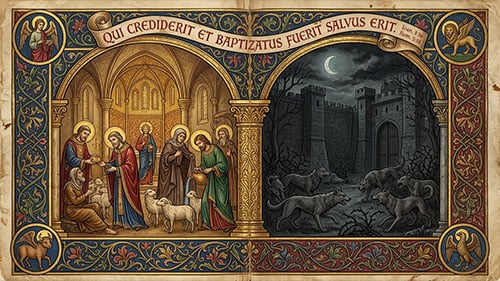 " />
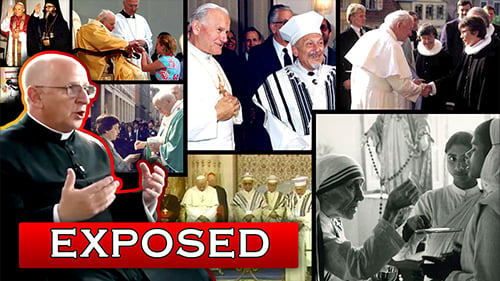 " />
 " />
 " />
 " />