November 30, 2025

The following statement of St. Thomas is interesting. He recognizes that some sinners are manifest by mere evidence of the fact, even if they have not been declared by a tribunal or judge. The same principle is recognized in papal teaching and canon law, as we’ve pointed out repeatedly. Such facts contradict the false arguments of many defenders of the Vatican II Sect. Many of them deny that someone can be recognized as a public sinner by notoriety of the fact itself without any declaration. They simply do not understand or adhere to Catholic teaching and principles.
St. Thomas Aquinas, Summa Theologiae, Pt. 3, Q. 80, A. 6: “A distinction must be made among sinners: some are secret; others are notorious, either from evidence of the fact, as public usurers or public robbers, or from being denounced as evil men by some ecclesiastical or civil tribunal.”
Settles The Question
Did St. Paul Really Rebuke St. Peter In Galatians 2?
Excellent video. 100% proof that Cephas in Galatians 2:9 is not St Peter. The connection with Galatians 2:1-10 and acts 11:26-30 settles the question.
Augustinus
Appreciate
How To Avoid Sin
… I greatly appreciate your posts that help me to follow God's will and become holy as he commands.
D Guzman
His Former Diocese
Syracuse “LGBT Churches” Prove Leo XIV’s Sect Isn’t Catholic
This is my former diocese…
Kyle
November 25, 2025

On Nov. 23, 2025, Antipope Leo XIV released a new document called In Unitate Fidei, to commemorate the 1700th anniversary of the Council of Nicaea of 325. Although the document is not very long, since it was written by the apostate Antipope Leo XIV it’s no surprise that it contains a number of ecumenical heresies. He speaks of all the baptized, including all the Protestants and the Eastern “Orthodox”, as “disciples of Christ” (#9), as “brothers and sisters in Christ” (#12), and as part of the “one universal community of Christ’s disciples” (#12).
LEO XIV TEACHES THAT THEY ARE PART OF THE CHURCH OF CHRIST
Antipope Leo XIV, In Unitate Fidei (#9), Nov. 23, 2025: “‘All of us, as disciples of Jesus Christ, are baptized ‘in the name of the Father, and of the Son and of the Holy Spirit.’ We make the sign of the cross on ourselves and we are blessed.”
Antipope Leo XIV, In Unitate Fidei (#12), Nov. 23, 2025: “… ecumenical dialogue, founded on one baptism and the Nicene-Constantinopolitan Creed, has led us to recognize the members of other Churches and ecclesial communities as our brothers and sisters in Jesus Christ, and to rediscover the one universal community of Christ’s disciples throughout the world.”
That is to clearly convey that all of those baptized heretics and schismatics belong to the Church of Christ, which is directly contrary to the dogmatic teaching of the Church.
Pope Eugene IV, Council of Florence, Bull Cantate Domino, 1441: “It [the Holy Roman Church] condemns, rejects and anathematizes all who think opposed and contrary things, and declares them to be aliens from the Body of Christ, which is the Church.”
Pope Pius XI, Mortalium Animos (# 11), Jan. 6, 1928: “Furthermore, in this one Church of Christ no man can be or remain who does not accept, recognize and obey the authority and supremacy of Peter and his legitimate successors.”
Pope Leo XIII, Satis Cognitum (# 9), June 29, 1896: “The practice of the Church has always been the same, and that with the consenting judgment [i.e. consensus] of the holy fathers who certainly were accustomed to hold as having no part of Catholic communion and as banished from the Church whoever had departed in even the least way from the doctrine proposed by the authentic Magisterium.”
Notice that according to actual Catholic teaching those who depart from even one dogma of the Church or the Papacy (e.g. the “Orthodox” and the Protestants) have “no part of Catholic communion” (Leo XIII) and are “aliens from the Body of Christ” (Eugene IV).
LEO XIV TEACHES THAT THEY HAVE THE SAME FAITH
In #12 of the same document, Leo XIV teaches that all the baptized (including the various Protestants and Eastern “Orthodox”) share the same faith in the one and only God.
Antipope Leo XIV, In Unitate Fidei (#12), Nov. 23, 2025: “We share the same faith in the one and only God, the Father of all people; we confess together the one Lord and true Son of God, Jesus Christ, and the one Holy Spirit, who inspires us and impels us towards full unity and the common witness to the Gospel.”
That’s actually a heresy, one that’s often overlooked. It’s often not recognized because 1) few understand Catholic teaching about “faith” and 2) Leo XIV’s statement (that non-Catholics share faith with Catholics) is so frequently expressed by the Vatican II antipopes that people have become desensitized to it. The truth is that heretics do not have any faith in God. To reject one dogma is to reject all faith.
Pope Leo XIII, Satis Cognitum (# 9), June 29, 1896: “But he who dissents in one point of divinely revealed truth absolutely rejects all faith, since he thereby refuses to honor God as the supreme truth and the formal motive of faith.”
Even though it’s directly contrary to Catholic teaching to assert that a heretic has any faith, the Vatican II antipopes have taught the false doctrine that heretics and schismatics, as well as Muslims and Jews, have “faith” on hundreds of occasions.
LEO XIV FULLY ENDORSES JOHN PAUL II’S ECUMENICAL ABOMINATION, UT UNUM SINT
In his new document Antipope Leo XIV fully endorses Antipope John Paul II’s encyclical Ut Unum Sint, which is filled with heresies and contradictions of Catholic teaching.
Antipope Leo XIV, In Unitate Fidei (#12), Nov. 23, 2025: “Exactly thirty years ago, Saint John Paul II further promoted this conciliar message in his Encyclical Ut Unum Sint (25 May 1995). In this way, together with the great anniversary of the First Council of Nicaea, we also celebrate the anniversary of the first ecumenical Encyclical. It can be considered a manifesto that brought up to date the same ecumenical foundations laid down by the Council of Nicaea.”
John Paul II’s abominable document Ut Unum Sint teaches the heresies that 1) Catholics and non-Catholics are in communion with each other; 2) that non-Catholics have the faith; 3) that there are non-Catholic saints and martyrs; and 4) that participation in non-Catholic worship is not only permitted but recommended. It explicitly endorses the outrageous Directory For The Application Of Principles And Norms On Ecumenism, promulgated in 1993 by John Paul II and the Council for “Promoting Christian Unity”. It’s essentially a manual for how to commit sins against the faith. It recommends the very actions that were specifically condemned by the Church, such as taking part in non-Catholic worship in non-Catholic churches.
The Directory For The Application Of Principles And Norms On Ecumenism #118: “In liturgical celebrations taking place in other Churches and ecclesial Communities, Catholics are encouraged to take part in the psalms, responses, hymns and common actions of the Church in which they are guests. If invited by their hosts, they may read a lesson or preach.”
John Paul II, Ut Unum Sint (# 16), May 25, 1995: “More recently, the Directory for the Application of Principles and Norms of Ecumenism, issued with my approval by the Pontifical Council for Promoting Christian Unity, has applied them to the pastoral sphere.”
The Church has always condemned the very activity that is endorsed by Antipopes John Paul II, Leo XIV, and the other Vatican II antipopes.
Pope Pius XI, Mortalium Animos (# 10), Jan. 6, 1928: “So, Venerable Brethren, it is clear why this Apostolic See has never allowed its subjects to take part in the meetings of non-Catholics…”
LEO XIV TEACHES THE NON-CATHOLIC “SAINTS” AND “MARTYRS” HERESY
As alluded to above, in his new document Leo XIV also quotes John Paul II to teach the blatant heresy that all the non-Catholic sects have saints and martyrs.
Antipope Leo XIV, In Unitate Fidei (#12), Nov. 23, 2025: “Saint John Paul II reminded us, in particular, of the witness of the many Christian martyrs from all Churches and ecclesial communities: their memory unites us and spurs us on to be witnesses and peacemakers in the world.”
That is a bold rejection of the dogma Outside The Church There Is No Salvation. In particular, it directly contradicts the dogmatic statement of Pope Eugene IV.
Pope Eugene IV, Council of Florence, Bull Cantate Domino, 1441: “No one, even if he has shed blood in the name of Christ, can be saved, unless he has persevered in the bosom and unity of the Catholic Church.”
Pope Gregory XVI, Summo Iugiter Studio, May 27, 1832: “Finally some of these misguided people attempt to persuade themselves and others that men are not saved only in the Catholic religion, but that even heretics may attain eternal life.”
John Paul II taught the “ecumenical saints and martyrs” heresy many times, but in Ut Unum Sint he expressed it in a particularly blasphemous manner. He wrote:
John Paul II, Ut Unum Sint (#84), May 25, 1995: “These saints belong to all the churches and ecclesiastical communities, which unlocked for them entrance into the communion of salvation.”
Latin: “Sancti hi ad omnes Ecclesias ecclesialesque Communitates pertinent, quae eis aditum ad salutis communionem reseraverunt.”
As we’ve mentioned before, John Paul II used the particular word “reseraverunt”, which means “they unlocked”. Thus, he not only taught the heresy that people can be saints outside the Church but he expressed that the non-Catholic sects themselves unlocked Heaven for them. That is to imply that those sects, and not just the Catholic Church which was founded upon St. Peter, have the keys to the Kingdom. It’s an astounding statement. We believe that John Paul II deliberately used the word “unlocked” to increase the blasphemy, for his modus operandi was to subtly mock God and the Catholic Church on a regular basis.
Leo XIV’s document is another clear expression of the false religion of Vatican II. It’s not the Catholic faith. He’s not a Catholic, and those who obstinately profess communion with him deny the faith. On Nov. 28, Leo XIV will participate in another ecumenical prayer service, which will be another public mortal sin against the faith and a further expression of heresy. He’s a non-Catholic antipope. The Vatican II Sect is not the Catholic Church, but the end-times Counter Church, as our material explains.
November 23, 2025

Nov. 23 is the feast of Pope St. Clement. According to the oldest list of the popes (which is found in St. Irenaeus’ work Against Heresies), he was the fourth pope (the third successor to St. Peter). His reign is dated by some to have been from AD 92 to AD 101. Irenaeus also says that Clement heard both St. Peter and St. Paul in person.
St. Irenaeus, Against Heresies, Book 3, Chap. 3, #3, c. 180: “This man [Clement], as he had seen the blessed apostles, and had been conversant with them, might be said to have the preaching of the apostles still echoing [in his ears], and their traditions before his eyes.”
Clement’s famous Epistle to the Corinthians is “the earliest piece of Christian literature outside the New Testament for which the name, position and date of the author are historically attested” [Johannes Quasten, Patrology, Vol. I, 1950, p. 43]. It was considered to be part of Scripture by many in the ancient Church and thus included in several canonical lists of the New Testament. It’s often cited as an early example of papal primacy. In the epistle Pope St. Clement (writing on behalf of the Church of Rome) admonishes the Church of Corinth, an Eastern church that was located almost 1000 miles away by sea. The tone of the letter indicates that the Church of Corinth is subject to the Church of Rome:
Pope St. Clement, Epistle to the Corinthians, 58:2-59:1: “Receive our counsel, and ye shall have no occasion of regret. For as God lives, and as the Lord Jesus Christ lives, and the Holy Spirit… if any disobey the words which He [God] has spoken through us, let them understand that they will entangle themselves in no slight transgression and danger; but we shall be guiltless of this sin.”
Pope St. Clement, Epistle to the Corinthians, 63:2: “For you will give us joy and gladness, if you render obedience to the things written by us through the Holy Spirit.”
His epistle also provides early support for the importance of confession.
Pope St. Clement, Epistle to the Corinthians, 51:1-3- “So, then, for whatever sins we have committed and whatever we have done through any of the tricks of the adversary, let us ask that we may be forgiven… For it is better that a man should make confession concerning his sins, than that he should harden his heart, even as the heart of them was hardened who made sedition against Moses the servant of God; whose condemnation was manifest…”
There is also a tradition that when he was exiled at Chersonesus Clement’s prayer caused a fountain to miraculously spring up for the help of Christians, and that many infidels were converted and baptized as a result of this miraculous flow of water. Clement died as a martyr under the emperor Trajan, in approximately the year 100. It is believed that he was thrown into the sea with an anchor tied around his neck.
November 21, 2025

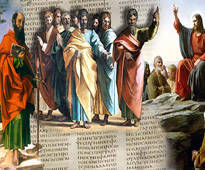
Our video called Did St. Paul Really Rebuke St. Peter In Galatians 2? covers many important points that are relevant to the biblical proof for the Papacy. One of those, which is explained below, is a particular term that James used about Peter’s statement at the Council of Jerusalem in Acts 15. Concerning Peter’s unique role in the incorporation of the Gentiles, Acts 15:7 says this about St. Peter’s actions at the Council of Jerusalem:
“And after there had been much debate, Peter stood up and said to them, ‘Brothers, you know that in the early days God chose from among you, that by my mouth the Gentiles should hear the word of the gospel and believe.’” – Acts 15:7
As the visible head of the Church, Peter spoke first and pronounced the definitive doctrinal decision at the Council. Contrary to what some say, it was Peter, not James, who made the decisive doctrinal statement at the Council. Peter proclaimed that gentile converts do not need to be burdened with the yoke of circumcision and all the requirements of the Old Law.
Peter said: “… and he made no distinction between us and them, having cleansed their hearts by faith. Now, therefore, why are you putting God to the test by placing a yoke on the neck of the disciples that neither our fathers nor we have been able to bear? But through the grace of the Lord Jesus we believe them also to be saved in the same manner.” – Acts 15:9-11
When Peter ended his speech in Acts 15:11, the very next verse (Acts 15:12) says:
“Then all the multitude kept silence, and gave audience to Barnabas and Paul...”
Scripture mentions the silence immediately after Peter’s words finish. This indicates that the multitude recognized the authority of St. Peter’s decision and position. As non-Catholic commentator on Acts Darrell L. Bock admitted: “The assembly became silent (ἐσίγησεν, esigēsen) as a result of Peter’s remarks (an ingressive aorist, Moulton and Turner 1963: 71).” (Darrell L. Bock, Acts, 15:12.).
The particular proposal made by James, the local bishop of Jerusalem, that Gentile converts should abstain from food that has been sacrificed to idols, from blood and from what has been strangled, which the Apostles decided to adopt, was a recommendation involving Church discipline, not dogma. It was a disciplinary measure adopted by the Church for that particular apostolic period, in which a single Church of Christ was forming from those who had observed the Old Law and Gentiles who had not. However, it did not bind for all of Church history, unlike Peter’s dogmatic declaration about incorporating Gentiles into the Church. Thus, Peter proclaimed the key doctrinal truth that would stand for all of Church history, not James.
In the first part of James’ speech, he makes reference to what Simon Peter had already said.
Acts 15:14- James said: “Simeon has expounded how God first visited to take from the Gentiles a people for his name…”
Using the Hebrew form of Simon (‘Simeon’), James refers to St. Peter’s speech near the beginning of his speech; yet, when Peter began to speak, he didn’t reference any other man. He simply mentioned how God chose him. Further, when James says Simeon 'expounded', the verb used in Greek is ἐξηγήσατo, a form of ἐξηγέομαι. The verb can mean to expound or relate, and it was often used in antiquity for purporting to reveal divine things. In fact, each time the verb is used in the New Testament, it refers to those who are reporting acts or statements of God or Heaven. The term 'exegesis' (ἐξήγησις in Greek) derives from the verb ἐξηγέομαι. Thus one could translate Acts 15:14 as: “Simeon has exegeted how God first visited to take from the Gentiles a people for his name”.
A Protestant commentator named Adolph Schlatter noted that Josephus (the ancient historian) used the verb as a “technical term for the interpretation of the law as practiced by the rabbinate”. The New Testament uses the verb six times, including for how Cornelius made the angel’s message known, and for how Paul and Barnabas, after Peter's speech at the Council, related God’s miracles in Acts 15:12. So, when James references Peter's speech near the beginning of his speech, he describes Peter’s statement as an exegesis of God’s revelation on the Gentile issue. That exegesis came first at the Council after Peter stood up and it silenced the assembly.
There are also the striking parallels between St. Peter's role at the Council in Acts 15 and King David's role at an assembly in Jerusalem in 1 Chronicles 28. They are discussed in the video mentioned above on Galatians 2 and in our video called The Bible Proves The Papacy.
Ireland & “Transgenderism”
"The Crime Problem Coming To Your Doorstep" - video
Here in Ireland, the government took all the assets and money from the bank accounts of a young teacher because he is speaking up and will not call a boy, a girl!.. The whole system is corrupt and are punishing all the family members who are rightfully speaking up against transgenderism!...
Mary W



 " />
 " />
 " />
 " />
 " />