December 30, 2025

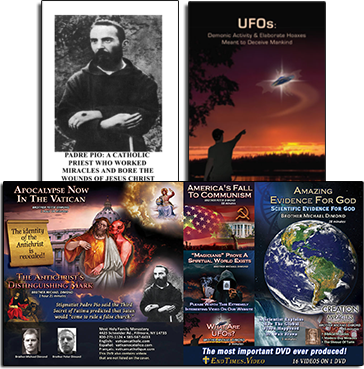
Our videos provide overwhelming evidence that the Vatican II apostasy fulfills prophecies about the Whore of Babylon, the return of the beast (or pagan Rome), the Antichrist, etc. See, for example (among others):
A Prophet Explains The Vatican II Apostasy From Catholicism
Apocalypse Now In The Vatican
The Temple Of God And The Antichrist Located
The Antichrist's Distinguishing Mark
We have also argued that the mark of the beast on the hand or forehead is a spiritual mark and a symbol of submission to the false ecclesiastical authority of the Vatican II Sect and its antipopes. The mark on the hand or forehead is therefore connected to the false worship imposed by the false authority of the end-times Counter Church. Well, it’s very interesting to note that St. Thomas Aquinas gives two possible meanings for the character/mark of the beast. He mentions 1) a malice connected to eternal punishment and 2) an unlawful form of worship. His identification of the mark of the beast with an unlawful form of worship corresponds precisely with our view and with what we’ve seen after Vatican II. The rites of all seven sacraments were changed after Vatican II. Invalidating changes were made to a number of them, including the Eucharist. An evil and unlawful form of worship has been imposed upon followers of the beast (i.e. the end-times Counter Church) by means of the New Mass, false ecumenism, and the veneration of the Vatican II antipopes (most notably Antipope John Paul II, who taught that every man is Jesus Christ). Here’s what St. Thomas said about the mark or character of the beast.
St. Thomas Aquinas, Summa Theologiae, Pt. III, Q. 63, A. 3, Reply to Obj. 3: “A character distinguishes one from another, in relation to some particular end, to which he, who receives the character is ordained: as has been stated concerning the military character (Article 1) by which a soldier of the king is distinguished from the enemy's soldier in relation to the battle. In like manner the character of the faithful is that by which the faithful of Christ are distinguished from the servants of the devil, either in relation to eternal life, or in relation to the worship of the Church that now is. Of these the former is the result of charity and grace, as the objection runs; while the latter results from the sacramental character. Wherefore the ‘character of the beast’ may be understood by opposition, to mean either the obstinate malice for which some are assigned to eternal punishment, or the profession of an unlawful form of worship.”
According to Catholic dogma, a spiritual mark or character is conferred by the sacraments of baptism, confirmation and holy orders. This spiritual mark or character appoints people for divine worship. The “character/mark” is therefore connected to the sacraments and divine worship.
St. Thomas Aquinas, Summa Theologiae, Pt. 3, Q. 63, A. 2: “The sacraments of the New Law produce a character, insofar as by them we are deputed to the worship of God according to the rite of the Christian religion.”
St. Thomas Aquinas, Summa Theologiae, Pt. 3, Q. 63, Art. 2: “… a character signifies a certain spiritual power ordained unto things pertaining to the divine worship."
St. Thomas Aquinas, Summa Theologiae, Pt. 3, Q. 63, Art. 6, Reply to Obj. 2: "Some sacraments, which imprint a character, bestow on man a certain consecration, thus deputing him to the divine worship."
It makes sense that the mark of the beast would be a direct contrast to the mark of Christ and therefore that it would involve a new and false system of worship. By means of these new rites deceived individuals (who wrongly believe they are following the Catholic Church but are actually following apostate antipopes) are appointed to the worship of the beast (by means of the veneration of Antipope John Paul II, the New Mass, etc.). This occurs by way of a massive spiritual deception and a takeover of the temple of God. See: The Temple of God and the Antichrist Located. The beast is pagan Rome under the guise or appearance of the Church, and it occupies the Church’s physical structures. This is why the followers of the beast “wonder” when they see the return of the beast/pagan Rome.
A SPIRITUAL MARK ON THE HAND AND HEAD IN THE OLD TESTAMENT
The teaching of the Old Testament supports the conclusion that the apocalyptic character/mark on the hand or forehead is spiritual rather than physical and that it symbolizes the false worship of the end-times Counter Church. In the Old Testament God commanded people to keep His words and observances as a sign on their hand and forehead. God was referring to a symbolic or spiritual sign on the hand and head, not a physical mark.
Deuteronomy 6:6-8: “And these words that I command you today shall be on your heart. You shall teach them diligently to your children, and shall talk of them when you sit in your house, and when you walk by the way, and when you lie down, and when you rise. You shall bind them as a sign on your hand, and they shall be as frontlets between your eyes.”
Deuteronomy 11:18: “Fix these words of mine in your hearts and minds; tie them as symbols on your hands and bind them on your foreheads.”
In fact, God mentions the spiritual mark on the hand and forehead in connection to observing the Passover.
Exodus 13:9, Regarding the Feast of Unleavened Bread commemorating the Exodus: “This observance will be for you like a sign on your hand and a reminder on your forehead that the law of the Lord is to be on your lips. For the Lord brought you out of Egypt with his mighty hand.”
Exodus 13:16: “So it shall serve as a sign on your hand and a symbol on your forehead, for with a mighty hand the Lord brought us out of Egypt.”
The Catholic Mass is the new Passover sacrifice that was prefigured by the ancient Passover sacrifice.
Council of Trent, Sess. 22, Decree on the Sacrifice of the Mass: “For, having celebrated the ancient Passover, which the multitude of the children of Israel immolated in memory of their going out of Egypt, He instituted the new Passover, (to wit) Himself to be immolated…”
So, the mark on the hand or forehead in the Old Testament was a spiritual sign or a symbol representing the proper observance of God’s laws and the sacrifice He instituted. It follows therefore that the apocalyptic mark of the beast on the hand or forehead is a spiritual sign that represents an improper observance of the Mass (the new Passover sacrifice) and a false ecclesiastical structure that deviates from the Lord’s commands and teachings. With regard to the aspect of the mark that deals with buying/selling, we believe that connects to the symbol of the beast (Europa) that is found on the currency of the European Union and the Vatican City State (the political dimension of the beast), as explained in our video Apocalypse Now In The Vatican. The beast has a political and a spiritual dimension. Also note that people are not directly said to be condemned for buying and selling with the mark of the beast but rather for receiving the mark on their hand or in their forehead (the spiritual mark). However, the fact that no one can buy or sell without the mark of the beast also applies, we believe, to the fact that true Catholics who will not submit to the Vatican II Sect and its false worship are denounced as “outsiders”, “schismatics”, “illicit”, and “unapproved”. People literally cannot function within the Vatican II Sect, economically or otherwise, without the mark. True Catholics are ostracized because they won’t receive the mark of the Counter Church, while people like James Martin are fully endorsed.
In our video called Saints & Theologians On The End Times we also showed that St. Thomas connected the end-times with a secession from the spiritual empire of the Romans, that is, with a general defection from the Catholic faith of the Roman Church. Hence, in two different areas St. Thomas’ comments on the end-times were remarkably prescient: 1) By recognizing that the mark of the beast potentially symbolizes a new false form of worship and 2) by asserting that a primary sign of the end-times is a secession from the spiritual empire of the Romans (i.e. a defection from the faith of the Roman Church).
Two other considerations support our conclusion about the mark of the beast. First, the mark of the beast is connected to the veneration of the image of the beast – the veneration of the one who was wounded. The evidence is overwhelming that John Paul II and his false canonization fulfill that prophecy. Since the veneration of the one who is wounded is fulfilled by the Vatican II Sect, it makes sense that the mark on the hand or forehead would be as well. Second, if the mark on the right hand or forehead were a physical mark, that would not deceive basically anyone. But the veneration of the end-times beast is imposed by way of deception. All of these points support the conclusion that the mark of the beast on the right hand or forehead is a spiritual mark that symbolizes the false worship and false authority of the Vatican II Sect, the end-times Counter Church.
December 27, 2025
Vatican II, Heretics & Ignorance Objection

Vatican II’s Protestant Heresy
What if a defender of the Vatican II sect says that the statements about Protestants and schismatics being in the Body of Christ in Unitatis Redintegratio #3 only refer to members of Protestant and schismatic sects who are invincibly ignorant?
Kristian
That doesn’t work at all because the paragraph (Unitatis Redintegratio #3) refers to “dissensions” (which includes people who reject Catholic teaching), and it speaks of all the members of these communities without limiting it to the supposedly ignorant. It also says this is true in spite of these differences. It also refers to the differences in doctrine as “obstacles”, rather than merely claiming that the individuals do not know Catholic doctrine. Further, it speaks of those who are separated from full communion, and a baptized person only separates himself from full communion through the offense of heresy, schism or apostasy (which involves a willful rejection or separation). Moreover, Lumen Gentium #15 says the same thing about those who “do not preserve communion under the successor of St. Peter”, which of course applies to people who dissent from or reject Church teaching. Hence, Vatican II clearly teaches that people who dissent from the Papacy and other dogmas are in the Body of Christ, which is the opposite of defined Catholic teaching. It also teaches that they are justified in baptism, as covered here. That’s also directly contrary to Catholic teaching.
Makes Sense
Protestants Misunderstand The Pharisee & The Tax Collector (Luke 18)
Amazing. I never heard it explained that way and it makes perfectly good sense...
Enrico
Eye-Opening
A Prophet Explains The Vatican II Apostasy From Catholicism
Very eye-opening and relevant. Thank you.
Lou
December 25, 2025

St. Thomas points out that Our Lord “willed to be born at Bethlehem, where David was born, in order that by the very birthplace the promise made to David might be shown to be fulfilled.” (Summa Theologiae, Pt. III, Q. 35, A. 7) This is why the New Testament accounts that deal with the circumstances of Our Lord’s birth repeatedly mention the connection to David. They emphasize that the birth occurred in the city of David and that Jesus was of the lineage of David.
Luke 2:4-5,11: “And Joseph also went up from Galilee, from the town of Nazareth, to Judea, to the city of David, which is called Bethlehem, because he was of the house and lineage of David, to be registered with Mary, his betrothed, who was with child… for unto you is born this day in the city of David a Savior, who is Christ the Lord.”
Luke 1:32: “He will be great and will be called the Son of the Most High. And the Lord God will give to him the throne of his father David.”
Matthew 1:18-20: “Now the birth of Jesus took place in this way… But as he considered these things, behold, an angel of the Lord appeared to him in a dream, saying, ‘Joseph, son of David, do not fear to take Mary as your wife, for that which is conceived in her is from the Holy Spirit.’”
Jesus’ birth in the city of Bethlehem was a powerful fulfillment of the prophecy in Micah 5:2, which was made approximately 700 years in advance.
Micah 5:2: “But you, O Bethlehem Ephrathah, who are too little to be among the clans of Judah, from you shall come forth for me one who is to be ruler in Israel, whose coming forth is from of old, from ancient days.”
At the time of Our Lord’s birth Bethlehem was the smallest town in the area. It was considered to be a very humble and insignificant location. Then Jesus was born in this tiny town, and He changed the entire history of the world. That is a striking fulfillment of Micah 5:2’s prophecy about “the one who was to be ruler”, which was made in the 8th century BC.
Indeed, Christ rules over all men since all things were committed to Him by His Father (Pope Pius XI, Quas Primas #17). However, this was manifested explicitly and powerfully by the Christianization of the Roman Empire, the many kingdoms dedicated to Him, and most importantly by the Church in which He spiritually rules. He rules on earth through His spiritual kingdom.
Pope Pius XI, Quas Primas (#15), Dec. 11, 1925: “This kingdom is spiritual and is concerned with spiritual things. That this is so the above quotations from Scripture amply prove, and Christ by his own action confirms it. On many occasions, when the Jews and even the Apostles wrongly supposed that the Messiah would restore the liberties and the kingdom of Israel, he repelled and denied such a suggestion. When the populace thronged around him in admiration and would have acclaimed him King, he shrank from the honor and sought safety in flight. Before the Roman magistrate he declared that his kingdom was not of this world.”
Pope Pius XI, Quas Primas (#33), Dec. 11, 1925: “He must reign in our minds, which should assent with perfect submission and firm belief to revealed truths and to the doctrines of Christ. He must reign in our wills, which should obey the laws and precepts of God. He must reign in our hearts, which should spurn natural desires and love God above all things, and cleave to him alone. He must reign in our bodies and in our members, which should serve as instruments for the interior sanctification of our souls, or to use the words of the Apostle Paul, as instruments of justice unto God.”
Micah 5:4 also says that the prophesied savior/ruler will “shepherd his flock”, and Jesus is “the good shepherd” (John 10:11). Micah 5:2’s statement that “His coming forth is from of old, from ancient days” also indicates that the coming ruler (the savior) would be divine as well as human, having existed from all eternity. This of course refers to Jesus being true God and true man, one divine person with two natures.
Bethlehem also means “the house of bread”, which was also providential; for Jesus is “the living bread who came down from Heaven” (John 6:51).
December 22, 2025

BRIEF HISTORY OF POPE JULIUS I AND ATHANASIUS
Pope Julius I’s Letter To The Bishops Assembled At Antioch (AD 341) is often cited as an important early example of papal supremacy. In that letter there are also statements that constitute further evidence for the absolute necessity of baptism. In AD 338-339 St. Athanasius (the Bishop of Alexandria) was unjustly condemned by a council in Antioch and replaced by an Arian named Gregory of Cappadocia. Gregory was installed in Alexandria in 339 with military support from Emperor Constantius II (an Arian sympathizer). Gregory remained in physical possession of the See of Alexandria until 345. This led St. Athanasius to flee to Rome and to the protection of Pope Julius I. The actions of Pope Julius and the Council of Sardica (AD 343) were instrumental in getting Athanasius restored to his see in 346.
EARLY CHURCH HISTORIANS ACKNOWLEDGE THE POPE’S UNIQUE AUTHORITY
In recounting these events, noted early Church historians Sozomen (who died c. AD 450) and Socrates Scholasticus (who died c. AD 440) both acknowledge the Bishop of Rome’s unique and supreme position of authority in the Church.
Sozomen, Ecclesiastical History, Book 3, Chap. 8 (AD 450): “The Roman bishop, on learning the accusation against each individual, and on finding that they held the same sentiments about the Nicaean dogmas, admitted them to communion as of like orthodoxy; and as the care for all was fitting to the dignity of his see, he restored them all to their own churches. He wrote to the bishops of the East, and rebuked them for having judged these bishops unjustly, and for harassing the Churches by abandoning the Nicaean doctrines. He summoned a few among them to appear before him on an appointed day, in order to account to him for the sentence they had passed, and threatened to bear with them no longer, unless they would cease to make innovations. This was the tenor of his letters. Athanasius and Paul were reinstated in their respective sees, and forwarded the letter of Julius to the bishops of the East.”
Sozomen, Ecclesiastical History, Book 3, Chap. 10 (AD 450): “Julius… alleged that there is a sacerdotal canon which declares that whatever is enacted contrary to the judgment of the bishop of Rome is null. He also reproached them for having deviated from justice in all their proceedings against Athanasius, both at Tyre and Mareotis, and stated that the decrees enacted at the former city had been annulled...”
Socrates Scholasticus, Ecclesiastical History, Book 2, Chap. 8 (AD 440): “Neither was Julius, bishop of the great Rome, there [at the Synod of Antioch – 338/339], nor had he sent a substitute, although an ecclesiastical canon commands that the churches shall not make any ordinances against the opinion of the bishop of Rome.”
Socrates Scholasticus, Ecclesiastical History, Book 2, Chap. 17 (AD 440): “Julius first replied to the bishops who had written to him from Antioch, complaining of the acrimonious feeling they had evinced in their letter, and charging them with a violation of the canons, because they had not requested his attendance at the council, seeing that the ecclesiastical law required that the churches should pass no decisions contrary to the views of the bishop of Rome: he then censured them with great severity for clandestinely attempting to pervert the faith…”
POPE JULIUS I ON THE BAPTIZED VS. THE CATECHUMENS
While referencing certain false charges made against St. Athanasius in the context of these events, Pope Julius I refers to the ancient liturgical tradition that dismissed unbaptized catechumens from the liturgy prior to the Mass of the Faithful. This is more evidence from the ancient Church that only the sacramentally baptized were considered part of the Body of Christ.
Pope Julius I, Letter To The Bishops Assembled At Antioch, AD 341: “In light of this testimony, we are trying to make out how a man lying sick behind the door was able to stand up, conduct the liturgy, and offer the sacrament. Or how could it be that the offering was on the altar with catechumens still present? If the catechumens were still inside, it was not yet time for the offering.” (Glen L. Thompson, The Correspondence Of Pope Julius I, p. 63)
Pope Julius I, Letter To The Bishops Assembled At Antioch, AD 341, speaking about the unjust trial: “At first we could not believe this, but the proof was in the official reports. We were astonished at this, and I think, beloved, you must also be astonished! Although priests entrusted with the celebration of the sacrament are not permitted to be present, an inquiry about the body and blood of Christ takes place in front of a secular judge with catechumens in attendance, and, even worse, in the presence of heathen and Jews, the slanderers of Christianity! If some offense had been committed, the investigation ought to have been conducted within the Church and, as usual, by clergymen, not by heathen who detest the Logos and know nothing of the truth. I trust that you, like everyone else, are aware of the enormity of this sin. This, then, is all I have to say concerning Athanasius.” (Glen L. Thompson, The Correspondence Of Pope Julius I, pp. 69-71)
POPE JULIUS I REFERS TO HIS UNIQUE AUTHORITY FROM ST. PETER
At the end of his letter to the Bishops of Antioch, Pope Julius I asserts the Apostolic Tradition that the Bishop of Rome has supreme authority
Pope Julius I, Letter To The Bishops Assembled At Antioch, AD 341: “Why were we not informed especially in the case of the church of Alexandria? Certainly, you cannot be unaware that, according to custom, we must be informed in writing before a just verdict can be determined. If there was some suspicion in regard to the bishop there, this church should have been contacted by letter. But those who have neglected to inform us and acted according to their own wishes now desire us to cast our vote with them against men whom we have not condemned! This is not the rule received from Paul or the practice handed down from the fathers; this follows a different pattern and a novel procedure. I beg of you, accept this patiently; what I write is for the common good. I am setting forth for you the tradition we have received from the blessed Apostle Peter. As I imagined this was evident to everybody, I would not have written if we had not been so troubled by the events...” (Glen L. Thompson, The Correspondence Of Pope Julius I, pp. 79-81)
Hence, in this noteworthy early papal document we see that both the Papacy (the unique authority of the Bishop of Rome) and the necessity of baptism are important and prominent aspects of the Christian faith.
December 20, 2025

Many Protestants argue that the parable of the Pharisee and the tax collector in Luke 18 supports justification by faith alone.
Luke 18:9-14- “Two men went up into the temple to pray, one a Pharisee and the other a tax collector. The Pharisee, standing by himself, prayed thus: ‘God, I thank you that I am not like other men, extortioners, unjust, adulterers, or even like this tax collector. I fast twice a week; I give tithes of all that I get.’ But the tax collector, standing far off, would not even lift up his eyes to heaven, but beat his breast, saying, ‘God, be merciful to me, a sinner!’ I tell you, this man went down to his house justified, rather than the other. For everyone who exalts himself will be humbled, but the one who humbles himself will be exalted.”
They claim that the story condemns any consideration of (or emphasis on) good works in connection to one’s righteousness. But they are wrong, of course. They misunderstand and misuse the passage. First, as anyone should be able to recognize, the tax collector whom Jesus says departed the temple justified did not rely on faith alone. He actually made a humble confession to God (before New Testament confession had been instituted). He was forgiven by his sincere act of confession to God, which includes a true intention to change his life. Thus, he was not justified by faith alone but by a humble and sincere confession.
Further, the Pharisee was not condemned for acknowledging a connection between good works and righteousness. Rather, he was condemned because he despised others, was full of pride, and trusted in his own righteousness to such an extent that he did not ask for anything to be forgiven him or added to him. Indeed, the very next chapter of Luke’s gospel (Luke 19) shows that an acknowledgment of one’s obedience or good works is not incompatible with righteousness. In Luke 19:8-9 Zacchaeus, another tax collector, tells the Lord that he has given half of his goods to the poor and not defrauded anyone.
Luke 19:8-9- “And Zacchaeus stood and said to the Lord, ‘Behold, Lord, the half of my goods I give to the poor. And if I have defrauded anyone of anything, I restore it fourfold.’ And Jesus said to him, ‘Today salvation has come to this house, since he also is a son of Abraham.’”
Zacchaeus recounts his good works to Jesus. Jesus responds by telling him that salvation has come to this house. The Lord would not have responded in this way if the Protestant understanding of salvation were correct.
Further, in Isaiah 38, King Hezekiah, who was near death, sincerely asked the Lord to remember his faithfulness and obedience.
Isaiah 38:2-5- “Then Hezekiah turned his face to the wall and prayed to the Lord, and said, ‘Please, O Lord, remember how I have walked before you in faithfulness and with a whole heart, and have done what is good in your sight.’ And Hezekiah wept bitterly. Then the word of the Lord came to Isaiah: ‘Go and say to Hezekiah, Thus says the Lord, the God of David your father: I have heard your prayer; I have seen your tears. Behold, I will add fifteen years to your life.’”
God accepts the prayer of Hezekiah and grants him 15 more years of life in response.
The very same chapter of Luke’s Gospel (Luke 18) also proves that the Protestants are wrong. In Luke 18:18-25, Jesus tells the ruler that he must keep the commandments and follow Him to attain eternal life. That is of course incompatible with the idea of salvation by faith alone.
Luke 18:18-25- “And a ruler asked him, ‘Good Teacher, what must I do to inherit eternal life?’ And Jesus said to him, ‘Why do you call me good? No one is good except God alone. You know the commandments: ‘Do not commit adultery, Do not murder, Do not steal, Do not bear false witness, Honor your father and mother.’ And he said, ‘All these I have kept from my youth.’ When Jesus heard this, he said to him, ‘One thing you still lack. Sell all that you have and distribute to the poor, and you will have treasure in heaven; and come, follow me.’ But when he heard these things, he became very sad, for he was extremely rich. Jesus, seeing that he had become sad, said, ‘How difficult it is for those who have wealth to enter the kingdom of God! For it is easier for a camel to go through the eye of a needle than for a rich person to enter the kingdom of God.”
In Luke 12 Jesus also speaks of a “faithful and wise manager, whom his master will set over his household” (Luke 12:42) who then acts immorally and the Master will “put him with the unfaithful” (Luke 12:46). That clearly indicates that someone who at one time is faithful and justified can cease to be faithful and lose justification as a result of immorality. In that context Jesus also says “you must be ready” (Luke 12:40) and “Blessed is that servant whom his master will find so doing” (Luke 12:43). In Luke 8:13 we also see that some people “believe for a while, and in the time of testing fall away.”
Those verses completely contradict the idea of faith alone and once justified always justified. These facts demonstrate that the Protestants are not only wrong about the parable of the Pharisee and the tax collector but that their false understanding of salvation is refuted by the entire New Testament.
December 19, 2025
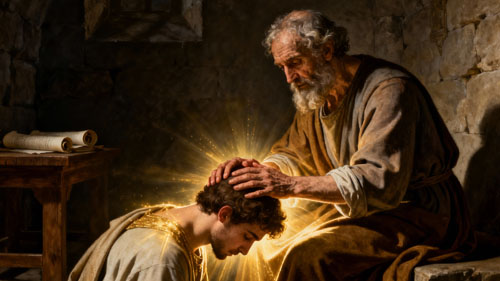
In 2 Timothy 1:6 St. Paul tells Timothy that the gift of God (τὸ χάρισμα τοῦ Θεοῦ) is in him through the imposition of my hands (διὰ τῆς ἐπιθέσεως τῶν χειρῶν μου). This refers to ordination. Since Scripture clearly says that a gift of the Spirit is transmitted through such an action, why is it hard for many non-Catholics to accept that the grace of God is bestowed through other actions such as baptism?
2 Timothy 1:6: “For this reason I remind you to stir up the gift of God, which is in you through the imposition of my hands.”
Very Informative
The “Catholic” Charismatic Movement Exposed
Very informative…
Serenetofu
Important Points
Eastern “Orthodoxy” Debunked On St. Peter’s Authority By St. John Of Damascus
Very good points…
S S C
December 17, 2025

Reports indicate that Antipope Leo XIV will be replacing “Cardinal” Timothy Dolan as “Archbishop” of New York City. He will appoint Ronald Hicks, another liberal apostate who was very close to the notorious Blasé Cupich of Chicago. Hicks served as “auxiliary bishop” under Cupich, and he is considered to have been his protégé and close ally. For a video that exposes the outrageous apostasy of Cupich, see this: “Cardinal” Cupich & The Counter Church In Chicago.
The reaction to this report by ‘conservatives’ in the Vatican II Sect is a revealing example of their bad will. Many of them don’t care at all that Hicks is a total heretic. Rather, they are simply excited because they think or hope that he might allow more ‘Latin Masses’ in NYC. As long as the Counter Church gives them a side altar in the ecumenical sect of apostasy, they are satisfied. They are deceived and rejected by God. Without the true faith it’s impossible to please God. Since they don’t adhere to God’s truth and the Catholic faith without compromise, their attempts at worship are in vain.
For a revealing video on the apostasy of “Cardinal” Timothy Dolan, see this: “Cardinal” Dolan & The Counter Church In New York City (NYC).



 " />
 " />
 " />
 " />
 " />